
We can lose sight of the fact that certainty is thought created and serves an intention or value. It can stop us being curious and seeking what is hidden from us.
The very nature of anything that appears uncertain suggests it is unpredictable and unreliable. It’s the inability to predict outcomes that generate fear, indecision, a lack of conviction and lacking in confidence.
“Doubt is not a pleasant condition, but certainty is an absurd one.” Voltaire
It’s a failure to accept the uncertainties of life that unsettle us and generates frustration. We find ourselves separated from the normal flow of life. The future we expected is now in question and there is then no clear indicator of the best way forward. What was once a reliable bridge into a predictable future becomes a precarious pathway of unreliable stepping stones.
For example, a journey to work seldom takes exactly the same time from one day to the next. You learn to allow more time or test different routes to cope with unexpected events. By considering alternatives you are showing flexibility and a desire to learn and adapt, not blame the world for your lack of understanding. Why hold on to a controlling ego when the situation is beyond your control? If you can accept the facts and change your thinking, new possibilities are likely to emerge. The diagram below explains the danger of trying to control uncertainty with a “quick fix” because this can lead to unintended consequences which keep repeating. A problem can persist unless it is reframed. This means seeing the problem in a different context or from a more positive point of view. A more sustainable solution can often be found

Making quick decisions in a complex situation can so easily produce unintended results because you did not see the interconnections. Each step depends on other steps and this can present new challenges. To a rational mind, when an existing pattern of expectations is not met it is unsettling and can cause anxiety, simply because the solution is not obvious. It’s tiring having to constantly reframe your assumptions by considering options until one makes sense to you. Embracing the uncertainty by wondering about and exploring possibilities can stop us from getting stuck in old habits and resentments. Just challenging old assumptions can create space for new insights to emerge and new actions to be tried.
“If we begin with certainties, we shall end in doubts. But if will we begin in doubts, we shall end in certainties.” – Francis Bacon
Exploring new territory
We can embrace uncertainty when we look beyond existing ways of thinking and being to explore new territory and find our way to new possibilities. By spending time reflecting on what is actually going on by using all our senses, it’s not the details that matter, but how we feel about the whole experience that dominates our thinking. We are trying to make sense of a situation as it’s happening and get a richer perspective.
The real voyage of discovery consists not in searching for new landscapes, but in having new eyes.” – Marcel Proust
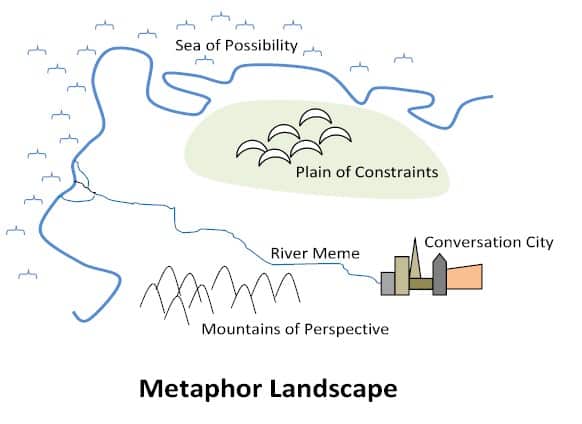
The diagram below explores these ideas as a metaphor. As we deal with the discomfort imposed by constraints a wider range of possibilities emerges. Conversations can also lead us to new insights and realisations that lead us to new perspectives that were previously unknown to us,

Diagram based on the work of Arthur Battram from his book Navigating Complexity

The ideas that this image could generate in your mind will depend on your own context and experience. Trying to make sense of unfamiliar territory can often promote strong emotions because you can struggle to cross the “plain of constraints” in your thinking until you discover a “sea of possibilities” in the recesses of your mind. You may have faced difficult challenges before from which you gained new insights from the “mountains of perspective” drawn from your own experience. It’s your brain that produces the “conversations” from which “river of memes” flows to give you the inspiration to embrace uncertainty. It takes courage to be bold when feeling fearful or vulnerable.
It is possible to be both curious and scared of what might happen if you cannot predict or control the outcome. Consequently, you might prefer to ignore or avoid what you don’t know. For example, you want to have a conversation with your boss about a pay rise but (s)he is in a bad mood. If you fear failure you might avoid the encounter. Next time, when the boss is more amenable, you approach the office with confidence, yet inside you are shaking. You still decide to walk away because you are afraid your nervousness will make you look incompetent. It’s your fear of the unknown, not your boss that is holding you back.
When you can embrace uncertainty with confidence, whilst still feeling vulnerable, you are more likely to succeed in solving a problem. You may be worried that you won’t be respected if you show weakness or don’t give a good first impression. This fear of the unknown brings you face to face with your vulnerability, especially when outside your comfort zone.
Facing vulnerability
It is not uncommon to feel inadequate when facing unfamiliar situations and you feel your credibility is at stake. Admitting that you don’t have an answer can make you feel a loss of power and control in that situation. It can feel as if your very identity is threatened. But this response comes from a fixed mindset where you constantly feel the need to prove your capability to others.
“Vulnerability is that intensely painful feeling or experience of believing you are flawed and therefore unworthy of respect” – Brene Brown
Instead of seeing every encounter as a game of winners and losers, use intuitive questioning to find patterns of thinking that suggest a preferred action in that context. This can involve:
Remaining open to the unknown
Asking more questions than giving answers
Asking open-ended questions of which you don’t have answers
Being open to surprises and the power of synchronicity
Engaging in ongoing cycles of exploration to seek new learning
Turning judgment into curiosity to create new possibilities
Converting disagreement into a mutual exploration of common ground
Use defensiveness to engage in self-reflection
You can alleviate the discomfort of uncertainty by not over-thinking situations. When you resist feelings or refuse to face facts you can get stuck. This limits your capacity to see alternatives, so you feel the situation or your interpretation of it can never change. You may feel that you do not have enough data or expertise to analyse the situation sufficiently to be confident of the next best action. There is also the danger that you resign yourself to the situation and become quiet and withdrawn, leaving it to others to make a mistake that you can blame them for.
Finding new opportunities
A common symptom of uncertainty is to feel you are “in the dark”. It makes sense, therefore, to throw light on the situation by being curious enough to understand what might be going on from a number of different perspectives. This can lead to learning and new knowledge when an insight emerges from that “sea of possibilities” that could not be seen from the “plain of constraints”.
“By holding on, we can destroy what we hope to preserve; by letting go, we can feel more secure by accepting what is.” – Margaret Wheatley
Just because something is not easily seen or was overlooked, as “not important”, we tend to place more value on what we already know than to question what we might be missing. As an artist will testify, there is more to be seen in the space between things than in the thing itself. The unseen when revealed provides an opportunity to open the mind to new experiences and learning.
In the 1990’s I directed a “Learning from Service Users Project” for Birmingham City Council and the Local Government Management Board. A range of public services opened themselves up to listen to their users and trusted their observations and experiences. Many of them reduce waste time and greatly improved customer satisfaction. But the services that felt they were the “experts” felt they had nothing to learn and refused to engage with their users. They did not want to be exposed, fearing they might be seen as incompetent. As one manager commented, “I wanted to introduce major changes as a result of user feedback and low staff morale, but I was hindered by an arrogant command and control manager who distorted the feedback to prove that the users did not understand and he knew best.”
Needless to say, those services failed to deliver Best Value for their service users, simply because they did not want to reassess their interpretation of reality. When something remains unknown or unseen it cannot challenge the status quo or demand change. It’s hard for some leaders to accept that they don’t know, even when the data suggests that urgent change is needed. Global warming is a good example.
“Dogmatism and scepticism are both, in a sense, absolute philosophies; one is certain of knowing, the other of not knowing.” – Bertrand Russell
Control or trust
Life Leaders give themselves permission to take responsibility and assume accountability for their decisions and promises. It takes courage to have trust in other people’s ability to grow and foster their own leadership skills by holding themselves accountable for their own promises. It requires a shift of mindset from direct control to self-managed learning from experience that can cultivate personal integrity and empathy.
Trustworthiness gives others the freedom to self-organise their priorities. It increases their own level of engagement and awareness of the positive impact they can have with greater positivity. Approached from a caring mindset and more action-focused conversations, you find that giving up some control can actually increase the power of others to grow and take more responsibility for their actions. This is an important step into a mindset that embraces uncertainty. You go beyond your perceived limits by collaborating with others using your conversation skills to manege offers and requests.
Feeling uncertain should prompt you to question your habits and accept the limited knowledge being used to make important decisions. One perspective is always going to be subjective and flawed in some way. Self-doubt is normal and healthy when there is no one clear way forward. Admitting doubt should not be seen as a weakness or a loss of trust as long as it is shared with the purpose of gaining clarity where the facts are unclear or consequences are uncertain. Sometimes there is a role for intuition and sharing insights.
Sometimes it is necessary to hold the tension between embracing uncertainty in the present and respecting experience from the past. The future may be uncertain, but your commitment to carry through with your intention bolsters your own confidence and can inspire others. You do not know what you are capable of committing to deliver on promises made to yourself and others.
Imagining the unseen
“Imagination is more important than knowledge. For knowledge is limited, whereas imagination embraces the entire world, stimulating progress, giving birth to evolution.” – Albert Einstein
Imagination is the capacity to envisage something that does not yet exist. Imagine the desired state or ideal result to imagine what would need to exist for it to happen. What attitude, knowledge or skill would be needed? What support, resource and expertise could help and where could be found? With imagination, you become curious. When issues interest you, they challenge and expand your thinking beyond what is immediately obvious.
Imagination to reveal what would otherwise be hidden and thereby not considered. Just by paying closer attention to events, you would previously have ignored can reveal new insights and shift your thinking. Instead of assuming that you know something, assume that you don’t and see how it changes what you see, hear or feel.
“I think we’re way too focused on creativity. It’s misguided. We should be focused on imagination. . . The real key is being able to imagine a new world. Once I imagine something new, then answering how to get from here to there involves steps of creativity. So I can be creative in solving today’s problems, but if I can’t imagine something new, then I’m stuck in the current situation. . .” – John Seeley Brown
The power of imagination to reveal what would otherwise be hidden and thereby not considered. Just by paying closer attention to events, you would previously have ignored can reveal new insights and shift your thinking. Instead of assuming that you know something, assume that you don’t and see how it changes what you see, hear or feel.
There is always someone who sees themselves as an expert who is prepared to give you an answer to a concern or dilemma. The problem with experts is that even although knowledge can only be partial, they have no doubt. Certainty in a VUCA world is not credible. Faith in a belief does not guarantee certainty. Just imagining alternatives in different contexts can generate a different truth, based on a different set of beliefs.
The lens through which you look at and interpret reality is often subjective and flawed, yet habitual thinking prevents you from exploring new possibilities. In a volatile and rapidly changing world, the knowledge and behaviours embedded from the past may not work in new situations. It’s about embracing an unknown future that is becoming increasingly less predictable, whilst at the same time assessing the current value of lessons from the past. The diagram below reflects an incremental view of change that creates a clear pathway towards a preferred future.

The questioning of long-standing beliefs and habitual assertions allows for a reassessment of what is being sensed in each moment. This enables a preferred future to be declared and the actions needed to produce a preferred future.
When the past presents many different and sometimes conflicting assertions, they have to be combined in ways that can only make sense in the present moment. A number of possible ways forward will then emerge and be assessed. This assessment will depend on which rules and values can be declared as unnegotiable and applied to fit a number of possible futures.
The diagram below reflects this process and how the uncertainty can result from imagining a diverse range of multiple perspectives and combining them to create a number of preferred future realities. 

The Brexit impasse experienced in the UK reflects the multiple interpretations that led to the questioning of the referendum result. The traditional views and rules of democracy were being challenged on the basis that it did not make sense to create a future that was uncertain and could make the country worse off. The diagram below identifies the elements that go into a complex strategic decision.

Diagram courtesy of the Human Systems Dynamics Institute
The inability of Parliament to agree “simple rules”, negotiate a shared “worldview” or find a consensus on how to resolve the tensions in current “reality”, left the citizens of the UK frustrated at the lack of certainty, an inability to engage with the opportunities presented by an unknown future.
Reframe your intentions
When leading in situations of uncertainty it is better to act with intention so that you are not attached to the outcome. When your focus is on what you want to have happened, you are more likely to commit to actions that serve your deeper intentions and not get distracted by taking actions that are conditional and deliver less than optimal results.
“You have a right to your actions, but never to your actions’ fruits. Act for the action’s sake. And do not be attached to inaction.” – Krishna
When you focus on the actions needed to get the result you want, you can become blind to the unpredictable nature of events and get lost in the emotional need to deliver a result – no matter what. When actions are driven by intentions or beliefs, they can reframe your thinking to deliver a result that matters.

Focusing on what’s important to you means, that even if something doesn’t work out as you intended, the action of itself will be enough to take you to where you would prefer to be. Fixating on getting a result, means you hold onto actions that will inevitably meet your needs, but never really satisfy you.
When you embrace uncertainty, no matter what you actually do, there will always be events outside of your control to be accommodated. That means many of the results you achieve won’t necessarily align with your imagined and preferred future because they seek to resolve conflicting concerns.
Searching for clarity
In the quest for high performance, effective leaders seek clarity by improving their personal and social habits. The urgency for action can become the enemy of the good when the leaders’ beliefs are driven to overcome fear and avoid punishment.
Let’s consider four dimensions in the process of seeking clarity that could improve the way you engage with everyday life.
1. Which three words best describe you as a person? In what ways are they reflected in the way you behave?
2. What three words best describe the way you treat other people? In what ways do the important people in your life experience these behaviours?
3. What three skills are you working on intentionally to improve your way of being and relationships with others?
4. Identify three simple ways you can add value to the lives of those you serve through your behaviour? What could you do with real clarity and focus that would help someone else gain clarity in the way they behave?
These simple questions can help to refocus your performance on the importance of self-awareness. It will expand your capacity to get clarity in your own thinking and that of others. It informs deeper listening, empathy, and the ability to influence perceptions. This places the focus on self-discovery and more contemplative practices that will generate a commitment to act in any situation.
Gaining clarity in situations of uncertainty requires you to deal with the human aspects of disruptive change, redundant habits, an unpredictable future and new learning. The ability to embrace uncertainty will support you as you engage with unpredictable change, increased complexity, and the ambiguity you will inevitably experience.
There comes a time when you realise you are not aware of the way you are listening. For example, you can listen to confirm your own opinions and judgements or look for things you don’t know already. You can also listen to connect at a human level and seek to understand how someone else makes sense of their world. There is also a way of listening to sense deeper connections that explore ideas that reveal shared concerns that need to be explored for mutual interest. Getting agreement on how best to tackle climate change would be a good example.
Grow by Chunking
When facing complex problems you have to act without fully understanding the cause-effect patterns and rules at play. Yet not acting could produce equally unknown results.
The science of Complex Adaptive Systems suggests that breaking down the multiple dimensions into interdependent parts that combine to produce an outcome. Each “chunk” is also made up of pieces that operate independently and share rules and feedback mechanisms where local systems impact on a bigger system that changes activity in the global system. Systems operate within smaller and bigger systems.
