
1. Introduction to the concept of complex intelligence
We are entering a new world. One that will transform organisational life and leadership. Bureaucratic silos need to be replaced with cooperative networks of teams that can work across functional and service boundaries. We are facing a decade of confusion and uncertainty if we don’t prepare for a VUCA world. Leadership skills must be distributed to embed human, artificial and collective intelligence into every team’s transactions.
This change requires deeper and more complex forms of intelligence that enable teams to coordinate their response to the volatility, uncertainty, complexity and ambiguity (VUCA) that is emerging in their environment. Working individually and collectively the team can integrate AI tools to orchestrate the way they critique and plan their commitments to each other and their stakeholders.
These teams need to commit to a regime that commits everyone to individual, group and social learning. This generates a more inclusive response to diverse challenges that can happen without warning. Uncertainty feels less of a threat when trust is strong, relationships are good and the work is fulfilling.
1.1. Living in a New Reality
Combining these intelligences will require different types of interactions, as roles shift to adapt to a rapidly changing context. AI tools become co-collaborators, contributing ideas and useful feedback (artificial intelligence capabilities). Social connections that critique ideas, data sources and models to stimulate creativity and critical thinking (collective learning capabilities). Individuals want to be engaged in authentic relationships, where they feel trusted, listened to and can share stories that reflect real time concerns and insights (individual intelligence capabilities).
An organisation that can adapt and sustain itself more effectively can reinvent the way it works to serve personal needs and team goals. When team members care about the effectiveness of their work and relationships, they can adapt quickly when the context changes. Everyone draws on leadership skills to support and energise each other, making problem-solving more collaborative, harmonious and equitable.
1.2. Blending human and artificial intelligence
Complex intelligence merges human intelligence (multiple perspective thinking) with artificial intelligence (step-by-step thinking) and collective intelligence (connected thinking). The synergy builds an adaptive capacity and an understanding of the patterns of behaviour that enable the team to navigate VUCA challenges
To succeed, team members must embrace complex intelligence by valuing the diversity of perspectives and skills that will enhance their career development. The distribution of leadership competencies in a team or a network of collorating teams gives everyone a voice in decision-making processes. The diagram below suggests the leadership competencies required in the different intelligences.

1.3. Learning to use LMM’s
Large Language Models (LLMs) and Agentive AI are raising the stakes for effective teamworking, Raising the level of curiosity and imagination will generate creative thought and innovative ideas. Everyone must be encouraged to support each others commitments with targetted feedback and insights to enhance team results and consider ethical considerations.
Introducing AI tools and normalising data sources presents challenges and anxieties around time for training, job insecurity, especially when status, long-standing relationships or feelings of fairness are ignored. Team coaching and paired mentoring will support change on the job, fostering personal responsibility, mutual respect, resilience and work flexibility. This creates a culture that values continuous learning and leadership practices in workplace relationships.
1.4. Distributing leadership skills
Team members need to see themselves as “agents” working together to find solutions to wicked issues. They commit to seeing through every offer and request they make of each other in every interaction. Complex and ambiguous connections beteeen data and people requires caring and collaborative relationships that serve the organisation’s vision.
Bold ideas will be required to ensure that leadership becomes a set of practices expected from all individuals. These are the practices that build quality relationships. They support effective communication and feedback from colleagues on actions would deliver improvemets.
1.5. Taking care of what’s important
The messiness of complex situations requires human resilience, intuition and new insights that emerge from a team learning together. An intelligent organisation listens and learns from its employees, customers and stakeholders, encouraging everyone to practice their self-improvement and self-regulation skills. These practices help create a culture where people know why they are there and take care of what they care about. This serves a sense of team achievement, personal value and cements social relationships.
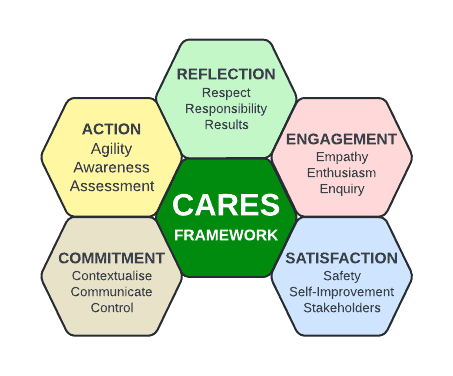
Working in a VUCA environment inevitably brings its pressures. I developed a performance management framework for a data centre construction team to be a high-performing team. Care holds the key to effective and moral action, as well as generating feelings of satisfaction. Effective and meaningful action must have a team commitment attached to it. That commitment is driven by a desire to influence each other to be the best performing team.


1.6. Having a strategic vision
The rest of this article explains how the organisation should be structured more like a Complex Adaptive System. Leadership skills are embodied in every interaction. Senior a managers have a role in establishing and reinforcing the rules that facilitating action based conversations that encourage collaboration. Their focus should be on coordinating and aligning the team’s commitments, assessing individual contributions and evaluating team performance.
Complex adaptive organisations operate more like networks of self-managed teams, where communication and feedback is facilitated across functional and service boundaries. Leadership skills then become an investment in the career potential of all employees, not just the preserve of team managers.
1.7. Team coaching and mentoring
Embedding AI skills must involve all employees being supported through team coaching. This engages them in real-time decision-making, active learning, creative problem-solving and addressing personal productivity issues. It’s the role of senior managers to lead by example and create the conditions for individuals to work more intelligently using AI tools.
Strong team relationships are cricial to foster a team culture that deals with personality difference and creates safe spaces to build trust, confidence and the commitment needed to deliver the organisation’s goals. Teams must care about and respect each other and feel they can commit to a vision of the future that they share.
1.8. Why is complex intelligence needed?
Complex intelligence skills cover a range of abilities that blend human and artificial intelligence. This must be augmented with the collective intelligence of team conversation. The diagram below teases out these three important domains of intelligence that are critical to a successful operation in a VUCA context.

Complex intelligence involves embedding leadership capabilities in all team members, to influence how a complex system works. Skills such as critical thinking, problem-solving, questioning, deep listening, empathy, agility, intuition, resilience, trust and reliability.
They must be developed, supported and evaluated within the team to enhance performance reviews. This ensures a greater sense of predictability in the performance of everyday interactions, making the team more adaptable, versatile and responsive to continuous and unpredictable changes in work processes.
The responsibility for coaching and facilitating the learning opportunities must be in the remit of a team leader, project manager or network coordinator. This creates a culture that values continuous learning and development to deliver on the offers and requests made to colleagues.
2. Adapting to the challenges of a VUCA Environment
2.1. Working in a VUCA environment
The focus for work in VUCA environment must be action focused to build resilience, collaboration and innovation. These behaviours must be assessed in everyone’s performance reviews. Team leadership skills can be included in ‘after-action reviews’ . This encourages reflection and critical thinking by sharing diverse perspectives and learning points that fit the context from four dimensions:
Volatility: The speed and unpredictability of change.
Uncertainty: The lack of predictability in actions and outcomes.
Complexity: The multiplicity of factors and their interconnections.
Ambiguity: The lack of clarity and potential for misinterpretation.
Creating self-organising teams
Leadership in a VUCA context must become more intuitive, insightful and creative in facing facts, exploring possibilities and embracing uncertainty. This requires a mindset that accepts ambiguity and bias as a given, flexibility in individual roles is needed to ensure the team stays connected and aligned with the organisation’s purpose. This requires team leaders to be collaborative, data-savvy, and willing to learn AI modelling skills to coordinate commitments and expertise.
3. Understanding a Complex Adaptive System
3.1. Is the system complicated or complex?
Organisations are like living systems. They have individual agents that interact with each other and work collectively to deliver a shared purpose and a culture that determines their rules for interaction. Complex systems have many interconnected parts involving many different types of relationships that can involve pairing or grouping. They can be networked (complex connections), that require multiple perspective thinking (used by human intelligence) or are hierarchical (complicated connections) that require step-by-step thinking (used by artificial intelligence).
3.2. What makes complex systems adaptive?
A system that is complex and adaptive has interactions that look chaotic but follow simple rules that can be observed as similar behaviour patterns. For example, when birds flock. Making sense of their patterns of interaction can reveal the rules and controlling relationships. These patterns can be observed in the way teams connect their ouputs, and workflow is structured. Some will be linear and others networked. When the system is adaptive, leadership practices can be observed in every interaction.
3.3. Augmenting human thinking and AI tools
A good starting point would be to master ChatGPT. It adds an extra dimension to Forcefield and SWOT Analysis and other tools used to crunch the data. This makes it possible to merge information, any instructions and expected outcomes. But humans must still do the thinking when judgements, choices and agreements have to be made.
Often solutions require crossing functional boundaries where different priorities for different customers and contexts have to be considered. The role of ChatGPT is to augment human intelligence. When situations are continuously evolving the data must be interpreted in real-time.
When issues need be solved in real-time, team’s can use “receiver-based communication” to share their collective intelligence. This works when everyone cares about learning on the job tand supports each other’s performance by sharing solutions.
The diagram below outlines the dynamics in a complex relationship between local (team) and global (strategic) influences. When someone with positional authority changes the rules of the game, they influence how other players interact. When the rules don’t work for the players, they interact and seek to influence those in authority. This relationship is explained in the diagram below.

Currently, America is seeking to disrupt local-global relationships by creating a VUCA environment. This creates tension in local interactions that believe in mutually beneficial cooperation and international law. Global power is seeking to weaken local interactions that threaten its dominance. The antidote is to increase democarcy in oranisations by empowering their employees to use their innate intelligence to keep AI under local control, avoid global dominance and strengthen local alliances.
You can download my handbook on ‘Influencing Change’ as a pdf document here.
4. Embedding leadership in a Complex Adaptive System
4.1. Leadership takes place in the interactions
When you watch birds flocking, you notice that they organise themselves without an identifiable leader. Observing their patterns of interaction, you notice that they follow simple rules to ensure that they keep together without bumping into each other. These and other behaviours are embedded in their interactions. They are connected by a shared consciousness based on human intuition that serves a common purpose.
Similar intuitive behaviours can be found in high-performing sports teams as they intuitively know what their colleagues are doing to support them. The leadership is shared and embedded in their interactions not in directions from the coach. The player holding the ball makes the decision in the context of the moment. The rest of the team self-organise to support a number of possible moves that could enhance their team’s performance.
Just like flocking birds, teams instinctively know how to behave in a given situation, and perform as a coherent group with a common goal. This transcends the slow and predictable way hierarchical thinking gets in the way of creative responses to local conditions.
4.2. Leadership is a way of being, not a position of authority
You could see leadership is an intuitive ‘Way of Being’ that takes care of what others care about. It embodies leadership in action focused language, attitudes and relationships. They are respectful and responsible in the way they interact with each other. This produces a culture where everyone listens to check out what is meant by what is promised and how it will be delivered for mutual satisfaction.
4.3 Leadership intelligence in a complex system
Effective leadership facilitates dynamic interactions in teams. It creates the conditions for creativity, adaptability and innovation to emerge . The core skills are distributed among all the “agents” in the system. The core competence is the ability to use different types of conversation to interact effectively using individual, collective and artificial languages that improve communication and action..
The diagram below summaries the core competencies. They stimulate critical thinking, problem-solving, analytical and communication abilities. They support the growth and productivity of individuals to connect and use their human ingenuity to sustain a viable system of many interconnecting parts..

5. Using complex intelligence in complex adaptive systems.
5.1. The challenge for leadership in a VUCA world
Complex intelligence gives leaders the capacity to understand, interpret, and respond to multifaceted and dynamic challenges. Such as mastering AI tools, data management and information search tools that enable “agents” to doing more with less, engage and include diverse perspectives to increasing productivity, etc.
A lots of pressure can fall on one individual in a hierarchical strusture, which is making it more fifficult to find one personal with all the required competencies. When everyone in a team shares leaership competencies and can think systemically, dealing with VUCA challenges becomes more intelligent and responsive.
Leaders cannot orientate themselves to think differently without emotional intelligence, empathy, a strategic perspective, effective communication, adaptability, resilience, creativity and the courage to innovate. If all “agents” develop and share these skills they will make better decisions and solve problems.
In fast moving unpredictable situations, with questionable data and resources, teams perform better. Senior managers contribute to teams by connecting with the potential impact of global concerns, such as energy usage, reducing waste, taxes, security, spiralling costs, skilled workers, struggling public services, etc.
5.2 Connecting intelligent systems
The biggest challenge is how to harness the different types of intelligence to navigate complex systems to achieve this kind of organisational transformation. It starts by accessing everyones innate calacity for leadership in their everyday private lives. Leadership must be seen as be an innate intelligence, available to anyone willing to realise their potential. Artificial intelligence is here to stay, so must be embraced as a way of enhancing human intelligence and ambition,. It must become everyone’s responsibility to care about each other’s health, welfare and performance. It will require new ways of observing, interacting and acting. Here are few examples:
5.3 How do we choose our best action when feeling overwhelmed or facing a messy situation with no obvious way forward?
a) Sharing what’s going on in your mind?
In an environment of constant change, we can struggle with ambiguous and diverse thoughts, feelings and behaviours. When the situation is volatile, unknown, complex, and ambiguous, we must reflect on the attitudes and moods that are influencing our choices.
We may need to reframe our thinking to question why we are not getting the desired results. Results are shaped by how we see our actions and interpret them. Our assessments depend on the results we value and what we care about. Our way of being determines what we notice and what makes sense to us.

Assessments will differ depending on our personal history, cultural background and what we notice. We need to be aware of what is influencing or missing from our observations. Maybe we are failing to see how we are being influenced those in authority or changes in our environment that are influencing our choices.
What distinctions are we making or assuming about what exists?
What criteria are we using to assess our choices? What else should we question?
What could we be missing that we didn’t notice or weren’t curious about?
If used intelligently, AI tools can help us to discover new facts, explore possibilities and wonder about what could be missing or confusing in our assessments. If we cannot accept difficult facts we get stuck and unable to be curious about alternatives. We must be aware of these issues when interpreting, questioning and assessing data.
This is an example of a negotiation template that could be used as a prompt for AI to produce a workflow model to monitor team interactiions and measure the outcomes of their commitments to each other.

b) Reflecting on what’s going on in the environment
Our “way of being” is created over time by how our nervous system senses and connects with our environment. Our observations are triggered by our feelings and thoughts that get embedded as habits and memories. Our mind reinterprets and regenerates our thoughts through the interpretations we make in the language we use. and hear. As we become more conscious of our thoughts, choosing what to do gets easier, more predictable, and life becomes less volatile, uncertain and complex.
It is advisable to ask if we are missing something. Are we being curious enough to question a belief or assumption? Are we being too quick to judge? Are these my points of view or someone else’s? These questions are also relevant when we come to construct a data request, critique the outcome and deciding what happens next when using ChatGPT.
If used intelligently, AI tools can help us to discover new facts, explore possibilities and wonder about what could be missing or confusing to us. If we are unable to accept difficult facts we can get stuck and unable to consider alternatives. We must be aware of these issues when interpreting, questioning and assessing data.
OBSERVATIONS – So, what are we seeing or not seeing?
We seldom see the world exactly the same way as others, so we should always keep our judgements open to review. As observers, we can only interpret what we are conscious of experiencing, especially in our conversations with others. It shapes what we notice, reflect on and choose to act on.
Context is, therefore, vital in determining what is important to us at a particular moment in time and how we adapt our thinking to changing priorities. We notice and make sense of sudden realisations and insights revealed in conversation and new information. The diagram below explains the source of individual intelligence that it chooses the actions to get our desired result.

Hindsight can be helpful, yet often unreliable. AI data can contain assumptions and interpretations from the past that could be out of date. Human memories, too, can be disruptive, making us a lousy judge of reality. AI tools enable us to face verifiable facts and be more objective in our assessments. Foresight in a VUCA world must imagine several possible future scenarios. It’s the unforeseen events and insights that reshape our intentions.
INTERPRETATIONS – So, what do these observations mean to us?
Observations will have their own “truth” about what we judge as “reality”. What’s true can be a complex mix of opinions, facts and guesses. Different perceptions produce different interpretations, which can be prejudicial, emotionally driven or difficult to verify. We should distrust conclusions when we know they are drawn from s they are always drawn from limited information.
We may have conflicting interpretations of what we think we are witnessing. We can test our worldviews in conversations with others and AI tools to experience a deeper understanding and awareness of our worldviews. Glenda Eoyang offers an ‘after-action review’ method to help us make sense of what is happening in the moment.

We must be leaders of our lives, alert to new thoughts, disagree with them, share our questions with others or use an AI tool. Open conversations can reveal further tensions and contradictions we were initially unaware of. Before making an important choice, we should test our options by questioning generalisations and assertions that are unverified, ambiguous or cannot offer a both/and solution.
ACTIONS – So, what can I do now that will deliver the following best action?
The priority here is to consider what methods or conditions are needed to establish enough common ground for a choice to be made. It must involve actions that will take care of what we say we care about and commit us to actions that can be evaluated.
5.4 Engaging complex intelligence means focusing on the interactions and interdependencies that require individual, collective and artificial intelligence to be effective.
For example:
Define the boundary. For example: What system are you focusing on?
What physical, psychological or emotional issue produces the patterns of interaction, tension, cooperation and decision-making you are observing?
For example, you are observing a cross-functional team of stakeholders or the scheduling of a complex project. What patterns of interaction would you be looking for to improve interpersonal relationships? What interactions could be a source of conflict in the group? Could it be poor listening, lack of respect, unwillingness to share concerns, unfair criticism, inability to accept a change of context, etc.
Potential for change. For example: What differences could make a difference?
Do you see differences in degree or type? For example, there could be 10 people on the team, each with a different degree of skill, knowledge, thinking ability and authority. What patterns of interaction would you improve that could make a difference – such as sharing concerns, changing seating layout, lack of clarity, missing expertise, no facilitator, etc? What changes could you make to improve the quality of interactions?
Exchange of thoughts. For example: What types of conversation are needed?
What type of conversations could achieve better connection, respectful feedback, common ground, listening to understand, commit to action, improve cooperation and share ideas? What patterns of language, mood and body posture could be identified that are getting in the way of listening with empathy, promoting trust, sharing experiences or exploring possibilities?
6. Examples of Complex Intelligent Conversations
6.1. Decision-making in a predictable environment
When employees are clear about what needs to be done, they can identify and then agree to key tasks, targets, team composition and a decision-making process. They can organise themselves to use appropriate AI tools to find and review relevant data sources, planning and work schedules. They can consult stakeholders and specialists to establish criteria for a preferred outcome. An example is offered in the diagram below.

A linear decision-making process can solve problems using a logical, step-by-step process. Each process element can involve AI tools to prompt questions and use collective and individual intelligence to evaluate each step and outcome. An unsatisfactory outcome prompts further questions about an AI tool to work on. This process can be replicated to refine the analytical method for future applications.
Human intelligence (individual and collective) works in harmony with artificial intelligence tools to build intuition, creativity, ethical concerns and emotional sensitivity into each step of the decision-making process.
In a team context, the method accesses the collective intelligence of other stakeholders to identify the relative importance of any controlling factors, challenging questions, potential breakdowns, etc.
Conversation is critical for ensuring clarity and a shared understanding of purpose. Careful listeners can ask more probing questions to get more precise answers. The diagram below is an example of critical thinking when listening and questioning.

Human reasoning skills are invaluable when teams discuss the outcomes from AI tools. It’s not just about clarity of communication and information sharing intelligent conversations require dialogue skills to get at hidden meanings and allow new understandings and agendas to emerge. These are essential skills for developing and using ChatGPT, Generative AI and Agentic tools in the workplace.
Intelligent conversation builds trust and provides clarity to commitment from others. When assessing opinions or making offers and requests, we bring a wide-range experiences and expectations for a better future. To verify the authenticity and accuracy of AI outcomes, everyone should be encouraged to look for inaccuracies, bias and ethical concerns.
6.3. Decision-making in an unpredictable environment
Intelligent conversations help us understand someone else’s decisions and how to reflect on our own. Glenda Eoyang identifies three ways of identifying key factors to make sense of a complex problem. See the diagram below for a summary,
Our worldview is where we consider the impact of our perceptions, assumptions and experiences of our world.
The rules, regulations and commitments that shape our decisions and
The day-to-day reality, context and data that informs or detracts from our decision.
All three perspectives require the application of complex intelligence. For example, the collection of information, the verification of facts, group agreements, individual perspectives, moral judgements, conflict resolution, etc.

Human intelligence enables us to see and sense the attitudes and perceptions that that can emerge from AI tool outcomes. Everything we decide will still be subject to reinterpretation by others, because the same conclusions can have different meanings. They can generate different emotional reactions and insights.
6.4 Assessing perceived differences and similarities
Conversation can help clarify the distinctions we make when explaining our preferences. We look to explore and understand differences and similarities. Collective intelligence tools such as Open Space Technology, Scenario Conferences or Future Search techniques are often used to allow stakeholders to share their experiences and knowledge to explore and find agreement when considering a wide range of perspectives.
Chat GPT tools are an effective way to avoid ambiguity by questioning definitions, getting at the facts and testing opinions to avoid misunderstandings. We can look for both/and explanations, be curious about the truth of our judgements and use “what if” questions to stimulate creative thinking.
Here are some questions to stimulate conversation
-
How do you deal with a loss of trust and re-establish quality relationships?
How do you accept personal responsibility for your failures to ensure you deliver what you promise?
How do you go about assessing the similarities, anomalies, and differences around an issue you care about?
How do you deal with uncomfortable facts and remain resilient to avoid feelings of resignation and resentment?
How do you free yourself from the myth of control over a VUCA world?
References
NOTE: You can find further information on the topics raised and an extensive range of learning resources and leadership practices on:
The Life Leadership website: https://www.lifeleadership.uk
Download my Handbook for Leadership and Coaching here