“A system is a perceived whole whose elements ‘hang together’ because they continually affect each other over time and operate toward a common purpose.” – Peter Senge
The diagram below explains a psychic system as a closed system that is self-generating and independent in action, conserving its unique experience of reality, producing a Way of Being that is bonded with its cultural environment.
Psychic systems connect through the “medium” of our body senses, observations, conversations, etc. Each psychic system has a mind, consciousness and the capacity for thought.

Psychic systems can contain family groups, races, religious affiliations, genders, wealth categories and social classes. These relationships exist inside and outside the boundaries of their own system, because they have common characteristics, roles or functions that share a “psychic identity”.

The diagram above shows how we take on different psychic identities (combining different roles) within a bigger system such as an organisation or a community. As we can be in any one of these identity systems at the same time, it’s our mind that is making the distinctions of who we are being in what context. For example, in a team, “YOU” can also be “US” when the identity is shared. Those outside the team are “THEM”, working in an environment that we relate to as “IT”. We wear many different masks as we perform different roles in our life movie as producers, scriptwriters and directors of our own actions. See Movie Makers.
They are called “psychic identities” because they are complex cognitive and emotional maps that we generate unconsciously inside ourselves as we grow up. For example, if “ME” and “YOU” don’t get on, then our relationship will change depending on where we focus our attention. We connect or disconnect.
This happens because we can make different distinctions in our identity to fit the context we find ourselves in. For example, with our children we can adopt an adult role in one context and act like a child in another.
In work situations we engage in conversations with our different identities as a worker, team player, manager, etc. We make promises to ourselves, to take care of something we care about.
We have conversations to coordinate our actions with others, showing care and respect for what we promise. We show this determination in our agreements, when we listen and speak with each other, connecting through an identity that projects trust with sincerity, commitment and reliability.

Where are the boundaries?
How we perceive these relationships helps us to understand systems thinking, where boundaries are dynamic (always shifting and creating different patterns) to generate different interpretations. When we make more distinctions we refine our identiies. But relationships also have a psychic identity that involves the “emotioning” of our reality.
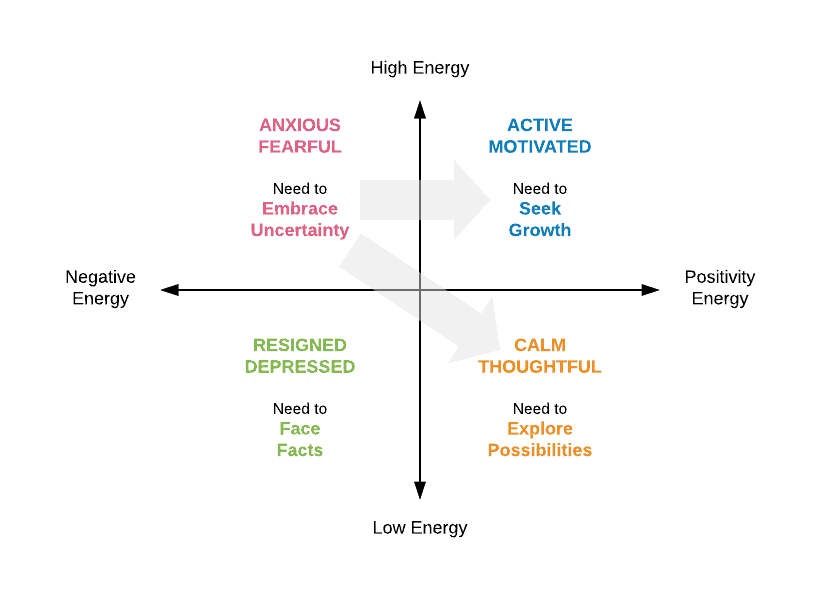
Each of us has a different perception of what and where the boundaries should be and what they mean to us. We can hold beliefs about ourselves that are only revealed through conversation or inferred by our behaviour or demeanour. It is expressed as our “psychic identity” observed as a mood state.
“You don’t see something until you have the right metaphor to let you perceive it.” James Gleick
Because these boundaries are mind created they can be perceived, shaped and reframed differently at any time of our choosing. We just have to want to explore what these relationships mean and what we want from them.
For example, President Trump in America and Brexit in the UK shifted the mood of nations, affecting their identity and how they feel about themselves and how they choose to express it. Suddenly, long-standing beliefs and values are challenged and reframed as we become aware of what other people want from “me” and what is “not me”.
Some of us want to cross the boundaries by empathising and considering people’s needs, whilst others want to strengthen the boundaries by making more overt distinctions to clarify identity. Black/White, Christian/Muslim, Male/Female. LBGT/Straight, Young/Old, Rich/Poor, etc. Whilst others become detached observers, others shared identities and concerns/concern .
What energises our identity?
You can see relationships more clearly when youobserve your own and other people’s “psychic identity” in a constructive and respectful way. One way is to identify the “Energy Producers” that are driving different relational behaviours. For example:
INSIDE-OUT ENERGY – If you had a strong and resourceful sense of who you are, and clarity about what is important to you, how would you share your beliefs and actions? We use different types of conversation clarify our identity and relationship in the similarities and differences we share.
BOTTOM-UP ENERGY – What emotions or mood state would you need that would predispose you to cross the system’s boundaries to find new possibilities and opportunities for engaging with others in the world? You may want to be inspiring/motivating, whilst in other relationships being supportive/compassionate.
TOP-DOWN ENERGY – What characteristics, strategies, and relationship structures would you adopt to influence others? In some situations, you are required to be authoritative/knowledgeable, whilst in others caring/questioning
OUTSIDE-IN ENERGY – How your sense of who you are, changes when you’re taking on a different identity to fit into a different world? When at work you could enter the world identifying as a colleague/boss, whilst at home, you enter the world of partner/parent.