The Nervous System
Structural Coupling – between you and your environment
To understand how we can adapt to rapid change in our environment we have to understand how we as human beings are coupled with our environment through our nervous system. One insightful way to understand this is to look at how we operate as human observers. This makes sense because everything we feel, describe, relate to and act from is an inside assessment of outside data.
“The nervous system is an expression of its structure of connections. Our behaviour arises because of the nervous system’s internal relations of activity.” Huberto Maturana & Francisco Varela ‘The Tree of Knowledge” p 126
This research tells us that our behaviour is structurally determined. Therefore, the structure of the external environment cannot directly specify changes in our internal structure. It can only trigger them. It is our capacity as observers that gives us access to the nervous system and how it structures our sensory responses – seeing, hearing, feeling, etc.
Making sense of what we observe
We give meaning to what we observe using our senses and the interpretations we make from the cognitive and affective processing performed by our brain. What we observe from the outside data becomes our way of being – seeing and doing. Although we may perceive things to be stable and consistent, they are constantly shifting. We seek to make sense of the changes to give them coherence. It either pulls us away (from our autopoietic, autonomous, adaptive system ) or pushes us towards (our autopoietic, autonomous, adaptive system). This depends on whether we sense in our environment a threat to our existence or an opportunity to enhance it.
The autopoietic system seeks to preserve the existing structures in our nervous system to decide what is “me” and what is “not me”. This is why it is difficult for us to change embedded habits and beliefs. We reject data that does not fit with our history, culture or experience. This is why policies, music, ideologies and new products have to resonate as “this is me” before we give it our attention. We can also get “infected” by these assessments/lies and then defend them as our own, even though they cannot be grounded in verifiable evidence. This is why we can be fooled by words that we think make sense to us as a listener, but are not what was meant by the speaker. When we seek to understand the true meaning we have to be “infected”. This is what these words are doing to you now. The medium for exchange is your mind connecting with another mind.
“When you plant a fertile meme in my mind you literally parasitise my brain, turning it into a vehicle for the meme’s propagation in just the way that a virus may parasitise the genetic mechanism of a host cell.” – Richard Dawkins ‘River out of Eden’
The diagram below shows how these aspects of our nervous system and our environment are moderated by the relative power of our “observer” skills.

What something “is” can be observed and defined differently depending on how conscious we are. It depends on what that something means to us, which is shaped by the mind’s thoughts from past assumptions, current assessments, and future aspirations. If we have fallen from a tree in the past, our feelings of fear in the moment will impact how keen we will be to climb a tree in future.
As observers, we can see a coherent picture because our Way of Being unifies four different domains to make sense of what it is seeing.

It is the observer that configures what is sensed in the environment which triggers structural changes in the nervous system that interprets what is being observed. This process is known as “structural coupling”, as observers we connect and merge the environment with our nervous system.
Should your fruit trees start to die your relationship and feelings towards them can change. The fear of losing the crop produces anxiety and loss of income from selling the fruit. Suddenly the only income you can see is from firewood. The same process emerges from other feelings of loss. We grieve, and worry about the future but cannot see a way forward or a way back. Only by shifting our mental state and we move in a new direction.
We observe ourselves, and other people in the context of how we relate to our environment moment by moment. We are noticing things in a particular physical and emotional state that may change in the next moment, simply because our intentions, expectations, and needs are always changing. Consequently, we are always expecting something to happen. But because we cannot observe everything our knowledge is always partial and we experience “blind spots”. It means we cannot predict with any certainty what will happen because the nervous system is making assessments in the present moment. Your observer brings into the assessment, assertions from past experience and predictions about the future. This enables us to communicate with other observers and coordinate our actions using shared predictions called “declarations”.

It’s important to recognise that our nervous system does not invent a chosen behaviour but it can expand it dramatically with exaggerated movements, feelings and language. This happens because our senses have been perturbed by our internal memories, judgements and perceptions or an external event that caused us physical or emotional pain.
The nervous system and the environment are closed systems. It’s our innate capacity to sense and observe that enables us to give meaning to what’s “out there”. For example, as an outside observer, we can watch a submarine manoeuvre its way around a reef, without knowing what is going on inside. The navigator in the submarine has to work with depth and radar sensors to control the movement. Similarly, we do not know what is going on in the mind and body of another person, but we can observe their Way of Being and draw conclusions from our own internal sensors.
This is important because if we allow “outside-in” energy sources to act on us without thinking we are giving away our responsibility to others to lead our lives for us. Likewise, if we allow “bottom-up” energy sources to shape our actions without considering the consequences for ourselves we not holding ourselves accountable for our choices. The danger is that we promise more than we can deliver, lose our integrity and end up socially or economically isolated. Our lives can then lose their meaning or purpose.
The diagram below seeks to explain how “me” and “you” operate from the same biology, but our nervous system develops different structures resulting from different interpretations of our environment. We also need to conserve what we believe is important to our ability to survive and thrive. The result is different “ways of being” and different ways of observing, sensing, trusting and relating to others. Because nervous systems are “autopoietic” (self-making and self-protecting mechanisms) they seek to conserve their own map of reality as independent and autonomous living systems. The map is not the objective environment, it’s our limited representation of it. The mind uses previous maps to fill in any spaces. It is these “old” versions that need to be challenged for accuracy.
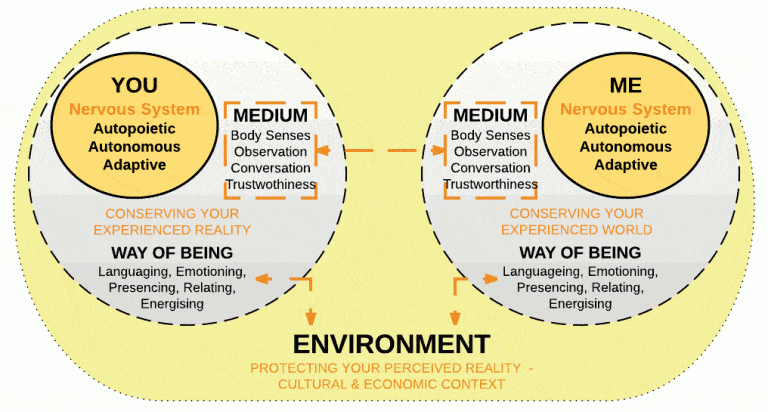
What’s interesting is that the relationship between the environment and the nervous system is shaped by coupling processes inside and outside the body. There is no physical connection as all communication crosses the empty space as verbal and body semses The architecture of system shows how each neuron is subject to a wide-range of “global” connections with all parts of the brain. But the results depend on the “local” synaptic connections. What is learned from these “local” interactions within the brain is that they are then redistributed throughout and influence other “global” connections throughout the brain that impact on future behaviour. This is a process known as “plasticity”. It enables broken connections to be repaired or strengthened, and new connections to be grown. This enables the process learning and unlearning
The Complexity Sciences refer to this phenomenon as “emergence”, where global structures emerge from the local interaction of individual agents which then feeds-forward to influence the behaviour of other individuals – and so on. This happens between human agents as we use our Way of Being” to “infect” and influence the behaviour of others and vice-versa. This offers us valuable insights into how complex networks of interactions are at work beneath the surface of what seem to be simple rules and relationships.
A tension exists between sources of energy that are “pushing-out” to explore possibilities and evolve, and the energy sources “pulling-in” to preserve and protect. This maintains the living system in a volatile, uncertain, complex and ambiguous environment so that it doesn’t stagnate or fall into chaos.
References
Self Power by Deepak Chopra. Harmony 2012
The Tools by Phil Stutz & Bary Michels. Vermillion 2012
Overcoming Destructive Beliefs, Feelings and Behaviours by Albert Ellis. Prometheus 2001
Nonviolent Communication by Marshall Rosemberg. PuddleDancer 2002
The Compassionate Mind by Paul Gilbert. Constable 2010
Stillness Speaks by Eckhart Tolle. Hodder 2003
The 10 Second Philosophy by Derek Mills. Hay 2012
The Zen Leader by Ginny Whitelaw. Career Press 2012
Way of Being by Carl Rogers. Mariner 1980
More Tools
– Noticing what’s happening and sensing what could be hidden from you.
THE CDE MODEL
– Identifying the conditions and rules that produce different patterns of interaction
THE OAR MODEL
– Improving your observation skills to choose actions to will deliver what you care about.
THE SCARF MODEL
– Identifying the core concerns that shape your emotional responses
ONTOLOGICAL LEARNING
– Understanding how to change your Way of Being
THE PSYCHIC SYSTEM
– Knowing how to change your Way of Being to fit the prevailing context
ONTOLOGICAL BREAKDOWNS
– Dealing with disruptions in the flow of your life
THE NERVOUS SYSTEM
– How you give meaning to to your experience of internal senses and external events.
QUADRANTS OF CHANGE
– Achieving a more holistic and balanced response to complex situations.
ACTION LOGICS
– Assessing leadership behaviour and effectiveness in different contexts
THE U PROCESS
– Using your senses to improve your effectiveness now to shape your future.
SPIRAL DYNAMICS
– Explaining the growth of human capacity and values
THE HEROES JOURNEY
– Finding a bigger purpose and passion to lead your life from.
ACTIVE LISTENING
– Knowing how to actively listen for understanding and empathy
REFRAMING
– Looking for possibilities to question and reshape perspectives.
THE OODA LOOP
– Achieving a bigger impact when working with other people
ADAPTIVE ACTION
– Examining the dynamic patterns of thought involved in decision making
THE LENS OF INQUIRY
Using the power of questions to get breakthrough results.
THE NINE PANES MODEL
– Discovering new perspecives when dealing with breakdowns in the flow of life.
THE JOHARI WINDOW
– Identifying alternatives to unseen or disruptive behaviour
THE FOUR TRUTHS
– Recognising and considering alternative perspectives in any situation
THE CIRCLE OF CONTROL, INFLUENCE & CONCERN
– Clarifying how you interpret what you see, hear and feel.
THE MIRACLE QUESTION
– In your ideal world, what do you want to be feeligs, thinking and doing?
A “BOTH/AND” PERSPECTIVE
– Dealing with paradox and ambiguity.
THE ADAPTIVE CYCLES
– Resisting breakdown and maintaining your viability for a breakthrough.
CREATING A WELL-FORMED OUTCOME
– Reducing the chance of facing unintended consequences.
WAY OF BEING
– Connecting words, emotions and body presence to be more effective.
CYNEFIN
– A sensemaking framework to help you crack different types of problems.
YOUR INNATE WISDOM
– Knowing what makes you who you are and using it to lead a more fulfilling life.