Active Listening
Active listening requires the involvement of two people where both body and mind are focused on creating a shared future. They are both seeking to trust and commit to what they can agree by adopting the language, a mood state, and energy level that focuses on creating a shared reality.
“Most people do not listen with the intent to understand; they listen with the intent to reply.” – Stephen Covey
Most of what we are taught about verbal communication is focused on speaking well and abundantly. This is something we do naturally and perfect over time, but listening is a skill that takes considerable practice to be effective. Listening well and abundantly is of equal importance, yet an undeveloped skill for most of us. My practices can teach you to notice, focus and train your listening skills to reveal a reality you’ve probably not experienced before.
Conversation is the medium through which each person’s sensory information is filtered before it’s received and assessed. The two processes involved are structural determinism and structural coupling. Both processes are involved in making sense and choosing what actions to take. This is the way two independent and autonomous living systems combine to create a coherent worldview that makes sense. There is no directly imposed thought or feeling, it is filtered through the medium of the nervous system using processes such as languaging, emotioning, presencing and relating.
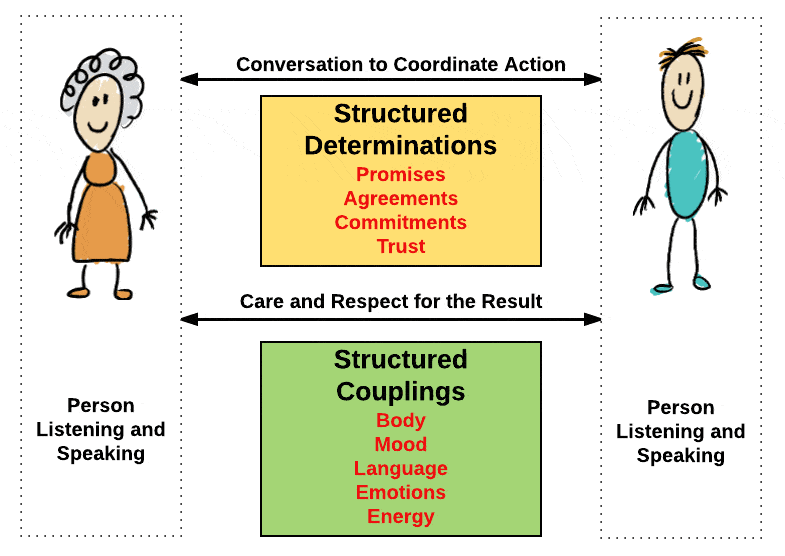
Good listening requires more than just paying attention to another person’s words. The meaning and intention behind the words can be observed in the way emotions, moods, energy and body movement are interpreted. For example, a mood can be energising, neutral or de-energising and is reinforced by a body posture and the words used. Words can be interpreted as a command, invitation, threat or plea, depending on voice pitch and tonation.
In active-listening, you are looking for coherence or incoherence in the whole body as the words are spoken. A leader or coach is taking in the whole ‘way of being’ to sense any unspoken concerns that might be revealed in a lack of coherence. For example, words of commitment are not reinforced by a confident body posture or a bright voice tone. Learning to observe and listen to the way comments are interpreted will affect the level of connection and any assessment of trust.
More Tools
– Noticing what’s happening and sensing what could be hidden from you.
THE CDE MODEL
– Identifying the conditions and rules that produce different patterns of interaction
THE OAR MODEL
– Improving your observation skills to choose actions to will deliver what you care about.
THE SCARF MODEL
– Identifying the core concerns that shape your emotional responses
ONTOLOGICAL LEARNING
– Understanding how to change your Way of Being
THE PSYCHIC SYSTEM
– Knowing how to change your Way of Being to fit the prevailing context
ONTOLOGICAL BREAKDOWNS
– Dealing with disruptions in the flow of your life
THE NERVOUS SYSTEM
– How you give meaning to to your experience of internal senses and external events.
QUADRANTS OF CHANGE
– Achieving a more holistic and balanced response to complex situations.
ACTION LOGICS
– Assessing leadership behaviour and effectiveness in different contexts
THE U PROCESS
– Using your senses to improve your effectiveness now to shape your future.
SPIRAL DYNAMICS
– Explaining the growth of human capacity and values
THE HERO’S JOURNEY
– Finding a bigger purpose and passion to lead your life from.
ACTIVE LISTENING
– Knowing how to actively listen for understanding and empathy
REFRAMING
– Looking for possibilities to question and reshape perspectives.
THE OODA LOOP
– Achieving a bigger impact when working with other people
ADAPTIVE ACTION
– Examining the dynamic patterns of thought involved in decision making
THE LENS OF INQUIRY
Using the power of questions to get breakthrough results.
THE NINE PANES MODEL
– Discovering new perspecives when dealing with breakdowns in the flow of life.
THE JOHARI WINDOW
– Identifying alternatives to unseen or disruptive behaviour
THE FOUR TRUTHS
– Recognising and considering alternative perspectives in any situation
THE CIRCLE OF CONTROL, INFLUENCE & CONCERN
– Clarifying how you interpret what you see, hear and feel.
THE MIRACLE QUESTION
– In your ideal world, what do you want to be feeligs, thinking and doing?
A “BOTH/AND” PERSPECTIVE
– Dealing with paradox and ambiguity.
THE ADAPTIVE CYCLES
– Resisting breakdown and maintaining your viability for a breakthrough.
CREATING A WELL-FORMED OUTCOME
– Reducing the chance of facing unintended consequences.
WAY OF BEING
– Connecting words, emotions and body presence to be more effective.
CYNEFIN
– A sensemaking framework to help you crack different types of problems.
YOUR INNATE WISDOM
– Knowing what makes you who you are and using it to lead a more fulfilling life.