Ontological Learning
Leadership is more to do with managing oneself and one’s environment to apply innate skills to create the desired effect. It’s not about managing routine activities. The focus is on dynamic processes such as problem-solving, creative thought, profound innovation and deep insights. The aim is to bring new thoughts and ideas into existence.
This involves learning about human ontology to help you understand your Way of Being, the way you use language, emotions and your body to create your world (REALITY MAKERS), produce energy for action (ENERGY PRODUCERS), emotional competence (MOOD MANAGERS) and lead a life of your own choosing (MOVIE MAKERS).
Realities of Leadership
Leaders in a VUCA world must be able to embrace uncertainty and disrupt the status quo with an inspiring vision and an ability to adapt with agility.
A Life Leader is someone who thinks about “being” a leader with an authentic presence, that can bring together a diverse range of views into a coherent strategy for change. The Life Leader has to be an ontological learner, recognising that attitudes are just as important as skills and knowledge. They welcome challenges to their assumptions and suggestions as a way of challenging their blind spots together with clarity to improve the quality of conversations. It’s not about qualification or knowing what it means to lead an organisation, it’s about a spontaneous and intuitive Way of Being. When the situation demands it, it’s knowing how to access your “inner director” and shift your Way of Being in order to fit what the context demands. The result is an enhanced level of consciousness.
There is no glamour in being a Life Leader. As soon as leaders let it be known what they care about, the challenges appear from nowhere. Expressing a passion or an opinion will draw criticism, offering ideas generates opposition, and taking risks brings failure and mistakes. Freedom to choose comes with constraints and proud achievements sit alongside humble apologies. Having high standards can sometimes be a lonely place to be, even when surrounded by admirers. Many a leader will tell you this.
One Perspective
From my own experience of leading and observing teams, managing projects, and coaching individuals, I have noticed that those who are leaders are “active choosers” rather than “passive receivers”. For example, trusting someone has more to do with your assessment of who they are as a person, more than the position they hold. Effective leadership and coaching are natural forms of self-expression.
Intention and passion create a more meaningful and fulfilling life for oneself and others. It’s not just about achieving goals. The pressure is on to lead by example, to show the authenticity and commitment that’s needed to explore the concerns of people seeking to shift their Way of Being to take them forward. They know what they are capable of and are determined to achieve it because they know who they are. It has more to do with self-respect and personal standards than results.
Those who “lead for life” know how good relationships build trust and how collaboration really matters if anything worthwhile is to be achieved. I observe these qualities in people who are aware of the need to influence and guide others to be better people. It’s about being your best self.
Introduction to a Life Leadership Model
An understanding of Human Ontology and how learning happens in the brain is vital. We must start from a point of discovering who we are and why we are here in order to get a handle on what we want to do with our lives. With that in place, we can move on to explore through practice how it will happen and where you want to build your alliances. It’s at this point that a life plan emerges from which you can transform your worldview.

Ontological Transformation
After thirty years of working within communities and organisations as a change agent, I seemed to “lose my fire”. I became discouraged by my inability to effect any meaningful change in the lives of professional people who were struggling to cope with the demands of having to do more with less. Everyone’s performance was improving, but often at a cost of declining health, happiness and well-being. So I questioned my own long-held beliefs and worldview. I felt as if I was …
“Casting pearls without getting even a pork chop in return” Ayn Rand
I entered a period of self-doubt and deep reflection, asking myself . . . What can I contribute as a person, not a position, to make people’s lives more meaningful and fulfilling? What I had not lost was my leadership for life. I was not going to retire and let life lead me. So I decided to become a vehicle for learning, how I could take leadership for my own life and discover more about myself and life my life purpose. I could then share my own learning and experience.
I decided to become a vehicle for learning and discover where I was leading from. I realised my leadership skills were embodied. I had produced my Way of Being in the world. I could see a way of sharing my learning and guiding others. I just wanted to be present for others and guide their own ontological learning when they felt constrained by life’s everyday concerns. This website is my vehicle for transformation. I am by nature a helper/teacher.
A New Level of Consciousness
Most leadership theories concentrate on external manifestations of leadership, but ontological learning uses imagination, intuition, courage, and creativity to grow from the inside-out. The focus for learning and competence lies in our level of conscious awareness in order to be the best human being we can be in our relationship with others and the world around us.
I started out doing community development work. I was operating from a “socialised mind. I wanted to help people get on with each other, create clubs, support people in need, etc. to please them by helping them shine and develop their lives. But then I wanted a young family and produce a movie of my own. I developed a “self-authored mind” get in control of my life and took on management roles.
It wasn’t long before I found myself training and doing consultancy work, convincing others that I had the answers if they would follow my lead. But as I moved into mentoring and coaching I had to question long-held beliefs, listening, observing and learning to be curious about my innate human capacities. I started to see my life from multiple perspectives to wrestle with life paradoxical nature as I searched for meaning and a life purpose in chaotic thoughts and conversations. I knew I had to adapt and embrace uncertainty if I was to grow into thinking from a “self-transforming mind”. This wasn’t easy, as I was constantly struggling with my imperfections. I had to find the courage to let go and lead life from my heart to learn how to live the life I wanted to live, not the life I felt I felt others wanted me to live.
I realised that growth comes from ‘breakdowns’ in the normal and expected flow of life. Mistakes, concerns and surprises can motivate change. When living through times of crisis we learn a lot about ourselves and discover the changes we can make in our Way of Being to move us forward. I discovered how ontological perspectives can be a powerful facilitator for self-awareness and and a vehicle for transformational change. My website is designed to help you travel a similar journey.
Being a Powerful Observer
You will see from the diagram below what amounts to leadership when it is viewed from the eye of the observer. As Life Leader, you are aware of your thoughts and how they shape the world you live in and the assumptions and judgments you make when deciding what action to take to get what you want. This is achieved through productive conversations and establishing many mutually helpful relationships that share high moral and ethical standards. In other words, you find yourself standing up for what you care about and are “walking your talk”.
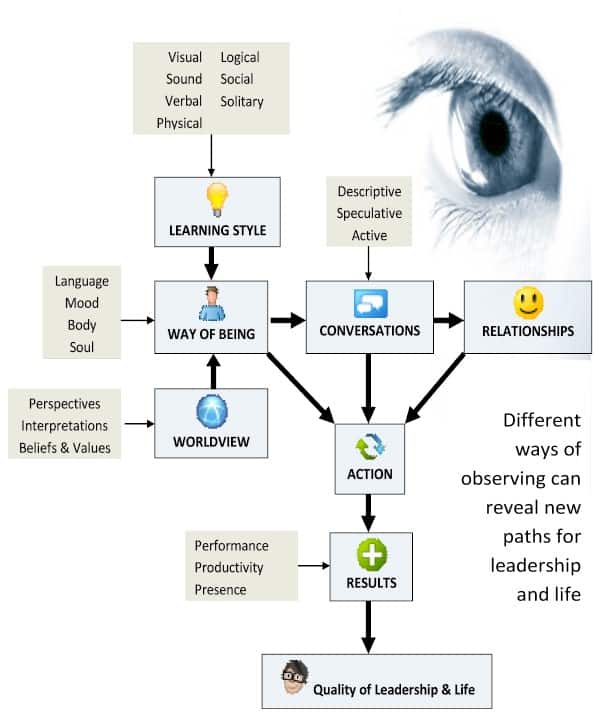
The diagram is based on the work of Alan Sieler at Newfield Institute “Coaching to the Human Soul”
Qualities of Conscious Leader
The quality of leadership and your life for that matter can be improved greatly by changing the way you observe and interpret your own thoughts and feelings. You see more of the patterns of behaviour and other events taking place around us. This requires a commitment to continuous reflection and the questioning of our own and other people’s worldviews. By doing this you gain new perspectives and the ability to reframe contexts to see new possibilities where none previously existed.
The diagram above looks static, but the processes are dynamic. This is because our language, moods and body postures “talk” to each other and are monitoring the impact as each one creates as feedback loops that we can then change consciouslyto stay centred.

We can intervene in our default way of being by shifting our actions in any one of four “ontological domains” and observe our impact on others and the results we seek. For example, a more upright and open posture can lighten your mood and cause you to talk to yourself in positive terms. Others notice a positive mood state and are more open to what you say. When you are creative in changing one aspect of your ontology the others align themselves to produce a mre authentic you. When they are not aligned, the flow of your life starts to breakdown. Life Leaders can adopt different approaches, but they will still be effective as long as their Way of Being is perceived by followers to be that of a “leader”.
Making it work for you
My website is an opportunity to learn and adopt practices that enable you to reflect on who you are, what’s important to you and what you are motivated to commit to. You will discover how to read situations and relationships so you can guide others in shifting their Way of Being and act in ways expected of someone exercising effective leadership in life and at work.
The best way to learn something so that you undestatnd it is to teach it. Listen to Simon Sinek.
Bill George and Peter Simms argue that an authentic leader displays four characteristics that represent people displaying their best selves as human beings, namely . . . . .
- Being Aware: – they are aware of their strengths, limitations, the perceptions of others toward them and what they stand for, and how their actions impact on others.
- Being Trustworthy: – they are perceived to be genuine and sincere, rather than phony or manipulative.
- Being Steadfast: – they know where you stand, who they hold themselves out to be for others and are grounded to the point where they can be straight with others, setting a consistently high standard for moral and ethical behaviour.
- Being Humble: – they do not rush to judgement, asking for help and building strong networks of collaborative relationships, soliciting opinions and diverse viewpoints before making important decisions.
I would add three more that will be found in a Life Leader . . .
- High Integrity: – being a whole, centred and balanced person, who is trustworthy nd builds trust through their way of being.
- High Commitment: – being passionate and determined to serve a cause bigger than your own personal interests enabling you to lead others to be their best selves and persist in serving the cause when the going gets tough.
- High Consciousness: – being aware of the perceptual and functional constraints in that emerge in any context that limits the ability to reframe one’s thinking and construct a more productive and meaningful response.
References
True North by Bill George and Peter Simms. John Wiley & Son 2007
Coaching to the Human Soul by Alan Sieler. Newfield Australia 2003
Immunity to Change by Robert Kegan & Lisa Lahey. HBR 2009
More Tools
– Noticing what’s happening and sensing what could be hidden from you.
THE CDE MODEL
– Identifying the conditions and rules that produce different patterns of interaction
THE OAR MODEL
– Improving your observation skills to choose actions to will deliver what you care about.
THE SCARF MODEL
– Identifying the core concerns that shape your emotional responses
ONTOLOGICAL LEARNING
– Understanding how to change your Way of Being
THE PSYCHIC SYSTEM
– Knowing how to change your Way of Being to fit the prevailing context
ONTOLOGICAL BREAKDOWNS
– Dealing with disruptions in the flow of your life
THE NERVOUS SYSTEM
– How you give meaning to to your experience of internal senses and external events.
QUADRANTS OF CHANGE
– Achieving a more holistic and balanced response to complex situations.
ACTION LOGICS
– Assessing leadership behaviour and effectiveness in different contexts
THE U PROCESS
– Using your senses to improve your effectiveness now to shape your future.
SPIRAL DYNAMICS
– Explaining the growth of human capacity and values
THE HERO’S JOURNEY
– Finding a bigger purpose and passion to lead your life from.
ACTIVE LISTENING
– Knowing how to actively listen for understanding and empathy
REFRAMING
– Looking for possibilities to question and reshape perspectives.
THE OODA LOOP
– Achieving a bigger impact when working with other people
ADAPTIVE ACTION
– Examining the dynamic patterns of thought involved in decision making
THE LENS OF INQUIRY
Using the power of questions to get breakthrough results.
THE NINE PANES MODEL
– Discovering new perspecives when dealing with breakdowns in the flow of life.
THE JOHARI WINDOW
– Identifying alternatives to unseen or disruptive behaviour
THE FOUR TRUTHS
– Recognising and considering alternative perspectives in any situation
THE CIRCLE OF CONTROL, INFLUENCE & CONCERN
– Clarifying how you interpret what you see, hear and feel.
THE MIRACLE QUESTION
– In your ideal world, what do you want to be feeligs, thinking and doing?
A “BOTH/AND” PERSPECTIVE
– Dealing with paradox and ambiguity.
THE ADAPTIVE CYCLES
– Resisting breakdown and maintaining your viability for a breakthrough.
CREATING A WELL-FORMED OUTCOME
– Reducing the chance of facing unintended consequences.
WAY OF BEING
– Connecting words, emotions and body presence to be more effective.
CYNEFIN
– A sensemaking framework to help you crack different types of problems.
YOUR INNATE WISDOM
– Knowing what makes you who you are and using it to lead a more fulfilling life.