Methods and Models
Leadership practices and coaching models used to make sense of systemic change in VUCA environments.

In environments dominated by complex interactions, where multiple parts, elements or agents, can interact and lead to the breakdown of decision making, control, accountability, feedback and desired results.
This is because complex situations have no single root cause. and contain multiple perspectives from a range of active agents. They can appear in many guises and can be measured in many different ways. They apply to individual thinking, team dynamics and large group interventions.
These methods and models are drawn from Quantum Mechanics, Complexity Sciences, Evolutionary Biology and Adaptable Systems, Neuroscience, Psychology and Business Management.
Below are a few examples that are explored in detail on the website.
Observe – Interpret – Respond

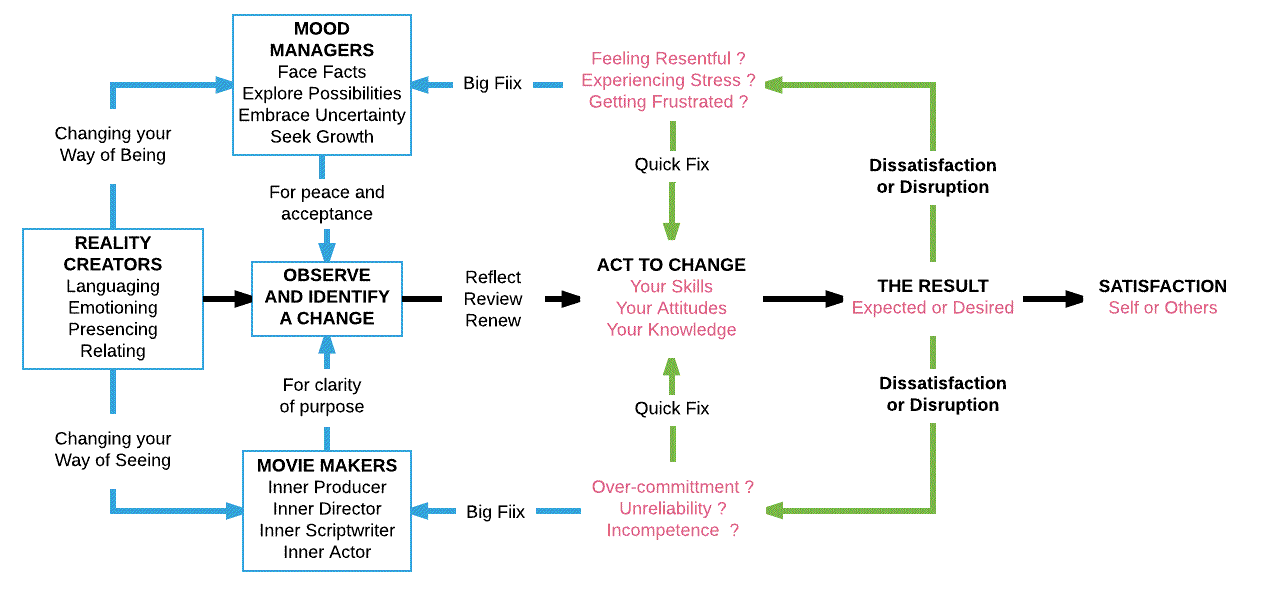
Changing Your Way of Being
Powerful Listening

The OODA Loop

The Promise Cycle

Grow by Chunking

States of Awareness

The BOAR Model
METHODS & MODELS
THE HUMAN OBSERVER
– Noticing what’s happening and sensing what could be hidden from you.
THE CDE MODEL
– Identifying the conditions and rules that produce different patterns of interaction
THE OAR MODEL
– Improving your observation skills to choose actions to will deliver what you care about.
THE SCARF MODEL
– Identifying the core concerns that shape your emotional responses
ONTOLOGICAL LEARNING
– Understanding how to change your Way of Being
THE PSYCHIC SYSTEM
– Knowing how to change your Way of Being to fit the prevailing context
ONTOLOGICAL BREAKDOWNS
– Dealing with disruptions in the flow of your life
THE NERVOUS SYSTEM
– How you give meaning to to your experience of internal senses and external events.
QUADRANTS OF CHANGE
– Achieving a more holistic and balanced response to complex situations.
ACTION LOGICS
– Assessing leadership behaviour and effectiveness in different contexts
THE U PROCESS
– Using your senses to improve your effectiveness now to shape your future.
SPIRAL DYNAMICS
– Explaining the growth of human capacity and values
THE HEROES JOURNEY
– Finding a bigger purpose and passion to lead your life from.
ACTIVE LISTENING
– Knowing how to actively listen for understanding and empathy
REFRAMING
– Looking for possibilities to question and reshape perspectives.
THE OODA LOOP
– Achieving a bigger impact when working with other people
ADAPTIVE ACTION
– Examining the dynamic patterns of thought involved in decision making
THE LENS OF INQUIRY
Using the power of questions to get breakthrough results.
THE NINE PANES MODEL
– Discovering new perspecives when dealing with breakdowns in the flow of life.
THE JOHARI WINDOW
– Identifying alternatives to unseen or disruptive behaviour
THE FOUR TRUTHS
– Recognising and considering alternative perspectives in any situation
THE CIRCLE OF CONTROL, INFLUENCE & CONCERN – Clarifying how you interpret what you see, hear and feel.
THE MIRACLE QUESTION
– In your ideal world, what do you want to be feeligs, thinking and doing?
A “BOTH/AND” PERSPECTIVE
– Dealing with paradox and ambiguity.
THE ADAPTIVE CYCLES
– Resisting breakdown and maintaining your viability for a breakthrough.
CREATING A WELL-FORMED OUTCOME
– Reducing the chance of facing unintended consequences.
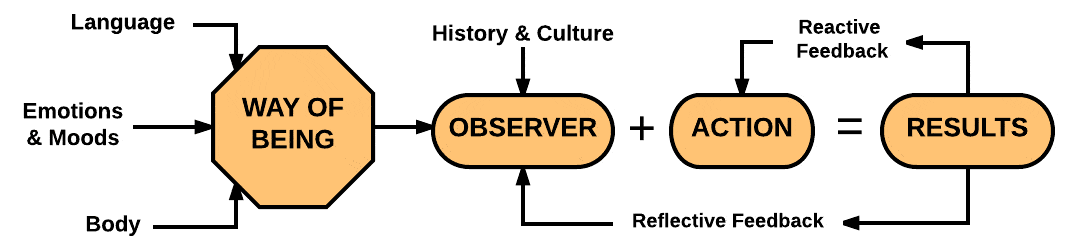
WAY OF BEING
– Connecting words, emotions and body presence to be more effective.
CYNEFIN
– A sensemaking framework to help you crack different types of problems.
YOUR INNATE WISDOM
– Knowing what makes you who you are and using it to lead a more fulfilling life.
A SOLUTION FOCUS
– Finding out what works and doing more of it.
INTERDEPENDENT PAIRS
– Resolving paradoxes and dilemmas when groups seek to maks sense of wicked issues.
THE DIFFERENCE MATRIX
– Uncovers the dynamics inside a human system and helps you understand the kinds of changes that are most likely to unfolding a diverse group.
THE NETWORK LEADERSHIP
– Uncovers the dynamics inside a human system and helps you understand the kinds of changes that are most likely to unfolding a diverse group.
TYPES OF SYSTEM CHANGE
– This model provides a description of the three main ways systems experience change and how you can best respond..
– Resolving paradoxes and dilemmas when groups seek to maks sense of wicked issues.
THE DIFFERENCE MATRIX
– Uncovers the dynamics inside a human system and helps you understand the kinds of changes that are most likely to unfolding a diverse group.
THE NETWORK LEADERSHIP
– Uncovers the dynamics inside a human system and helps you understand the kinds of changes that are most likely to unfolding a diverse group.
TYPES OF SYSTEM CHANGE
– This model provides a description of the three main ways systems experience change and how you can best respond..
– Uncovers the dynamics inside a human system and helps you understand the kinds of changes that are most likely to unfolding a diverse group.