
LIFE LEADERSHIP DOMAINS
MOOD MANAGERS
– Facing Facts
– Exploring Possibilities
– Embracing Uncertainty
– Seeking Growth
REALITY CREATORS
– Emotioning
– Presencing
– Relating
– Languaging
MOVIE MAKERS
– Inner Producer
– Inner Director
– Inner Scriptwriter
– Inner Actor
ENERGY PRODUCERS
– Inside-Out Energy
– Outside-In Energy
– Top-Down Energy
– Bottom-Up Energy
Facing Facts
Learn how to move on from mistakes and the constraints that blind us to the possibility of living in a better future.
Moods are part of your internal navigation system – your personal SatNav. But if you don’t see them you cannot change the way the world appears to you. Negative emotions come and go, but a negative mood can persist, producing anxiety and depression. You are then in danger of damaging your health and well-being. What you say and do is strongly influenced by the mood you are in at the time.
Facing facts requires acceptance of what cannot be changed, like the loss a job or a loved one. It may involve accepting a temporary mishap, like the loss of your phone or an argument. To face up to the facts of a situation is to accept what is outside our control which can reduce your anxiety. Remember anxiety is just an emotion, resignation is a mood state which we have the power of freewill to change. When you feel stuck and the situation is unpredictable all you have is hope that comes from optimism, curiosity and imagination.
When you learn how to notice, name and navigate eight basic emotional states (see below) you can quickly move your thoughts away from feelings of insecurity and resignation to become more confident and ambitious for a better future.  “Moods are predispositions to action that orient us to specific types of behaviour. Accepting something we cannot change enables us to move forward with curiosity and explore opportunities for more productive actions” – Prof Alan Sieler.
Bear in mind that good moods can also produce “blind spots”, stopping you from thinking and acting positively enough to address your concerns. You can use these simple actions to:
- ground the facts in your assessments by questioning their logic.
- explore the possibility of accepting alternative ways of behaving, allowing you to move forward.
- embrace and use the surprises and opportunities presented by life’s uncertainties.
- open your heart and mind to have humility and grow in gratitude for life as a human being
Controlling your mood state will take regular practice. Knowing how to maintain a positive mood state requires you to observe how you are feeling, thinking, communicating, behaving and reacting in the moment. You must be able to observe the mood you are in, name it, accept it and change your response to it. It’s harder to get stressed when you are in a positive and happy frame of mind.
Grounding Assessments
You “ground” your assessments, judgements or opinions by providing relevant and compelling evidence that can be easily verified and convinces your listener to accept its validity and authenticity. An assessment should set a context, direction or attitude that will motivate people to act on something that they can agree, care about and trust. An assessment is essentially a personal evaluation. It is neither true or false.
When assessments are grounded they become assertions because they can claim something that is accepted as true of the world. They can then be substantiated or refuted with the new observable evidence. Grounding is a complex skill as we have to acknowledge the listener’s standards for acceptance if they are to trust it. That’s important because we may want to use them as a basis for committing to an action or delivering on a promise. Intuition, blind trust or a good feeling will not be enough. It’s the listener, not the speaker that decides if a statement is grounded enough to get their agreement or acceptance. So, grounding can involve a number of key questions.
- Does your assessment fit with the listeners’ beliefs?
- To what exactly does your assessment apply in that situation?
- What are the concerns being expressed? Do you care deeply about what others care about?
- What value or satisfaction can you see the results delivering?
- What facts are offered, and can they be corroborated? Do they make a convincing case?
- What are the supporting assessments? Can the the facts be validated?
- Does the speaker come across as confident, authentic and centred?
- Can the speaker be trusted? Do they come across as sincere, reliable, respectful, caring, honest, fair-minded?
- When and under what circumstances would the assessment not be valid?
Living with Gratitude
It may seem odd to suggest that you should always question objective facts, as they are largely subject to interpretation. A fact may be verifiable but you have to give it meaning. But it can make a real difference in the way you lead your life. Leadership is like life itself, you are grateful for the chance to change things, but you are always having to question things. The way you deal with transitions in your life is reflected in how you would lead change in others and an organisation. If you cannot predict the future, it makes sense to pause and wonder what could happen and be as prepared as you can for alternative scenarios that could emerge.
“Most people don’t live in the moment; they just want to race into the future. They are forever regretting the past, or anticipating the future; forgetting to get the most out of this very instant.” – Jean Webster
Being grateful for surprises as well as what you have at this moment will help you tolerate any lack of control you may feel. For example, you are expected to know about those things that you are accountable for. You tend to pay attention to the important things you love or care about.
Sharing your gratitude for the things that matter to you will help you communicate a empathise with the concern and cares of others. It is then more likely that others will want to show that they also care and can be trusted to commit to those shared values. You can only influence what you cannot control, and what you cannot influence concerns you.
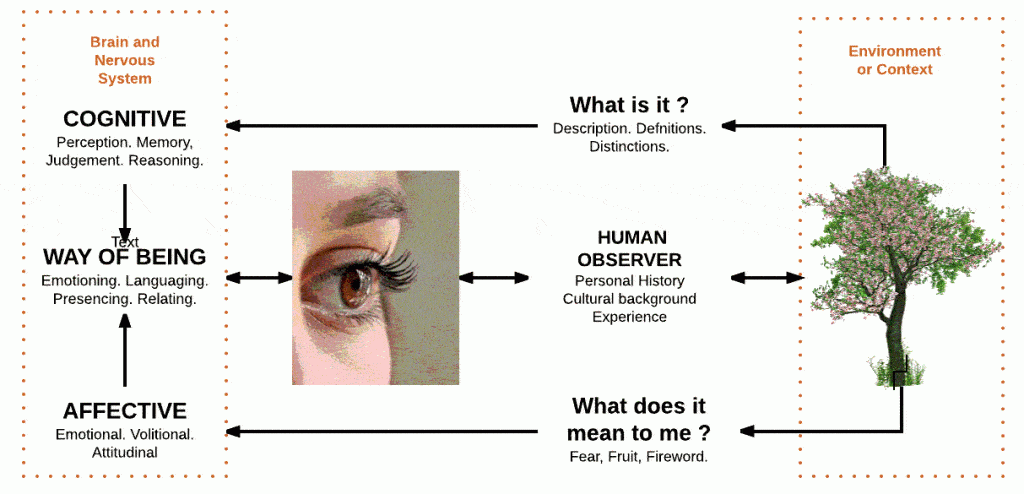
The diagram below explains how what we see is influenced by the “observer” that we are. We can get stuck in past perceptions and the attitudes we attach to them. For example, a tree that caused you pain or fear could stop you from seeing a tree from a position of gratitude as the provider of shelter, food and heat. So a fact is not what it is but what it means to you and how you relate to it. When this happens you see a different tree, even though it is the same tree.
The Power of Assertions
Whenever we listen or speak, our mind is asserting something that is true for us and it happens in language. It enables us to share our reality, establish relationships and get things done. When we believe in our assertions they are treated as facts, bringing certainty and stability into the flow of daily life.
When we see facts as our truth they are human creations, accepting that what is perceived as factual in one context may not be in another context. It’s wise to first make an assessment with a questioning mind. Just because someone says something is true if it isn’t backed up with verifiable evidence it cannot be asserted as fact. It’s just an opinion. Facts it seems are subject to different interpretations and meanings. Is it a gross or net future? (one is deleted) Which period does it relate to? (could be a distortion) Is it generally accepted by the public? (a sweeoing generalisation).
We hold on to our opinions as if they were set in concrete. Governments are particularly good at changing definitions and measures, as they attempt to generate a different reality in the minds of voters. Even in science, the facts established in one piece of research can be undermined the next day by another piece of research. Facts have to be seen to make sense in a specific context or period in time. Unless, that is, we can agree on what is a “universal truth”, with everything undisputed – even facts.
It is up to each of us to assess if a “fact” is true, false or subject to it being proved to us. There are some facts we need to believe in because to reject them would threaten our identity, such as being good at something. But facts can also be a source of suffering. If we lock ourselves into a particular worldview or frame of reference, such as feeling guilty, it can stop us from moving on. This stuckness can cause anxiety, resentment, and resignation.
An Ontological Constraint
There are always going to be constraints and limitations to what we can observe and act on. Our fears, mental blindness, and personal experience are just a few. Our disabilities, state of health and location can impose physical constraints. Our assumptions, attitudes, and perceptions reflect our personal history, work environment and the culture we grew up in. They all play a part in the habitual and unconscious way we see our world (a perceptual constraint) and the limitations on our capacity to use language, moods, emotions and our body (a functional constraint).
If we are behaving habitually in a way that becomes an obstacle to our performance this remains as a perceptual constraint until the behaviour is recognised and changed. When we are made to feel guilty as a result of something said to us, which stops us from performing at our best, this is a functional constraint.

The perceptual constraints live in the background of our life, shaping the beliefs and values that shape our actions and reactions in different situations. They are part of our worldview. How we make sense of things depends on where we stand. Our reality is just a perception. We experience it as reality because it just is. It’s our nervous system automatically processing sensory information. Our reality is an unconscious creation. But because our nervous system is always learning in response to sensory information from our environment we can change our Way of Being (our ontology) as a shift in our frame of reference.
Recognising our Ontological Constraints
We think our eyes act like cameras recording our life like a video recorder. We perceive ourselves as self-authoring. But we have an “inner director” that chooses where our attention is directed and acted on. It’s known as DAN our attention network that directs our attention towards something specific and is stimulated when we sense something novel.
We become aware when the BROCUS area, our “inner scriptwriter”, produces the words that the CEREBRUM uses to align our thoughts and make sense of what is being observed, turning the words into a story for the “inner director” to work with. It is our LIMBIC system that acts as our “inner producer” providing us with the passion and energy that stimulates our nervous system that behaves like an “inner actor” that is revealed to the outer world as our Way of Being. When we observe our Way of Being we are watching the results of our internal MOVIE MAKER. Watch this video and see it working.
It is this cognitive blindness that makes our thoughts and behaviours habitual. It is this ‘ontological constraint’ that must be recognised if we are to avoid drifting into a mood of resentment or resignation. We can give meaning to what is said to us without seeking to understand or validate what we believe is a fact. Sometimes misunderstandings arise because we are “deaf” to what is being said and so misinterpret the message that we thought was being sent. The tendency then is to blame the speaker for not being clear enough. This may be the case, but we have a responsibility to question for clarity and make sense of what is being asserted.
Consequently, asserting our own interpretation can stop us from inquiring into possible ways forward. We alter what our eyes see and our ears hear to fit with what we want to see and hear. We give our own meaning to the data that comes into our brains. It gets filtered. We are not motivated to spend time looking for more productive action. We can only pay attention to a few things at once, so it is better to unfocus and connect with what we already know and what makes sense to us. Otherwise, we could expend lots of energy getting stuck in a loop of endless justification. It is better for our health and sanity to generate feelings of gratitude, accept what we cannot change and look for alternatives. We can then go forward with a more open and focused mind and trust a less rigid way of thinking that allows us to adapt our actions and get results that work for us.
Reflecting on Action
When we reflect on the beliefs and values we use to generate and interpret our thoughts and observations, the emotions that emerge when we assess those thoughts can determine what we see, the actions we take and the results we then get. The resulting moods and emotions we experience will predispose us to act in specific and often habitual ways. This is why just doing something faster has little impact on the quality of results in the longer term. We have to feel and think about something different in order to do it differently.
If we cannot accept or reject our way of thinking as just one perspective of many we are less likely to embrace new ideas. More possibilities for action will not be actively considered. When we are able to see those facts from a different perspective, we can generate a whole new mindset of thoughts and feelings to act on. Think about how your world changes when you receive good or bad news. How you react depends on how you choose to see it. How you see it influences how you feel about it and this shapes what you choose to do. The result you get is not just what actions you took, but what influenced your choice of action.
Transforming Thought and Action
We can effectively shift our whole ‘way of being’ by shifting what we value. If we value our health we will not damage it with unhealthy thoughts, feelings, and actions. Adopting this ontological approach to the way we lead our life offers us a fresh perspective and opens up new possibilities for improving the relationship between our inner actor and inner director. The diagram below explains that to achieve transformational changes that allow us to explore how our feelings. thoughts and values impact on the actions that will deliver us life-changing results.

It is our Way of Being or the way we act and direct our life that shapes the observer that we are. We can self-author our reality in much the same way as a scriptwriter creates a story – the scenes and the actions needed to tell that story. We become grounded in the story which becomes our life. It shapes how we interpret what could possibly happen, or want to happen in the future. To move beyond the facts we have to accept and be grateful for life’s diversity and celebrate the common ground. For example, if we value that being alive as a human being is of higher importance than our differences with others, we will find inner peace and acceptance in society. Love and respect can connect us at a deeper level.
Ever thought about how other people play parts in your life movie and you in theirs? Perhaps they are not paying you the same level of attention. They are appearing in your movie, but they have a lead role on their own. We need each other to make our stories happen. We use offers and requests to encourage others to work with you to get things done for mutual benefit.
Understanding the Arrow of Time
Unfortunately, time only goes in one direction. Any assessment made in the present is going to be based on prejudices and conclusions drawn from past experiences. How we behave in the moment can change the way we are in the next moment if we shift the ontological background which shifts the behaviour that shapes the future that emerges. Our inner scriptwriter decides which words, metaphors and movements are produced and how we bring assertions from the past to shape any declarations we make about the future. This process is shown more graphically in the diagram below.

Diagram courtesy of Chris Chittenden at Talking About Pty Ltd
Assessments can only be made in the present and are therefore influenced by the mood we adopt in the moment. If we are constrained by our mood, we may believe that there is nothing to be gained from changing. We then feel stuck and our mind stays immune from any new ideas or possibilities that others might suggest. We cannot perceive an alternative perspective fearing the consequences of moving out of our comfort zone. Our past experience imposes a set of beliefs that we accept unconsciously and regard as “the truth”, as indisputable facts. If they remain unquestioned we cannot change the thinking that will open our minds to alternative ways of being and doing.
There is a growing body of research that suggests there is a time-lapse between when our brain makes a decision and we become aware of it. Are we leading our life or is life leading us? The jury is out on this. If true, we are passive spectators in a virtual life movie that our brain is producing, directing and scripting for us to act in.
The key to being able to act with a conscious intention is awareness, our ability to observe how we are observing a reality that we are creating. It suggests we are never in the present we are always generating a future by giving new meaning to past perceptions of experiences.
Beau Lotto talks about “delusion” as an important tool for creating new and powerful perceptions because it allows us the change our brains – and thus future perceptions from the inside-out. We are blind to these delusions which become assumptions that determine what we think and do that then shape what we do next. We create different assumptions because we perceive different possibilities. Our brains enable us to imagine new worlds as stories that we turn into movies.
Questioning Perceptions
We know that what the brain chooses to see is not what is in front of us. So we won’t perceive the world as it is. What appears to be a fact can be an illusion or an interpretation that does not fully reflect what others can see. The constraint here is that we can be blind to the fact that we are blind to what we could potentially see but our brain is not paying attention to. We need to appreciate that others may see things that we have missed. If we choose to reject or oppose a fact this can lead to resentment and we remain stuck. If we accept that our brain has the ability to distort, delete and generalise information, it is better to accept this fact when it’s pointed out to us so that we can shift to a more positive mood that will allow us to move on.
“We cannot see anything until we are possessed with the idea of it, then we can hardly see anything else” – Henry David Thoreau
Have you noticed how when you shift your frame of reference or get distracted you focus on it more and become unaware of what you noticed before? This is an ‘ontological constraint’ on your perception of the facts because you are no longer considering what you did before you were distracted. In other words, we only see what we are looking for. For example, we are often unaware of how we go about interpreting what we hear. The process is automatic and habitual. This is because we are always listening to the quick fix dialogue inside our head which intuitively interprets what comes to us from the outside-in. So, when we listen to other people talking we are constrained and shaped by how we would normally interpret what was said to us in a given context. We cannot distinguish what we are unaware of. Our mind shuts off or believes it “knows” what another person is trying to say based on our previous experiences, not their’s, or assumptions about a particular person, type of person or situation.
Dealing with Resignation
A mood of resignation stems from our inability to accept or reject the facts or the possibility of finding an alternative way of seeing things. We can get trapped in our assessments of ourselves and other people. This happens when we believe we have no other course of action, but to be who we are now. We are unaware of the distortions and deletions we have created in our listening and assumptions. Our ability to face facts and move on depends on how things occur to us, shaped by our history or cultural constraints. We often create misunderstandings because of the distinctions we have chosen to make – or are unable to make.
By stepping back and accepting that our knowledge may only ever be partial, the mood that emerges from our resistance to facing facts can lead to unproductive action. By accepting unchangeable facts we can shift our focus and energy on the positive and the possible. This generates a new mood of enthusiasm that leads us to see alternative actions. This is how we lead our life. We allow ourselves to declare a better future, not by ignoring the facts, but by trying to move beyond the constraints they have generated in the mind.
Becoming Detached
Life in the modern world has created more and more distinctions that can isolate us from one another. The world of facts and measures is detaching us from our life energy which senses and shapes who we are. We argue about what’s right and wrong and what the facts are telling us. We are disconnecting ourselves from our natural wisdom, compassion, and somatic intelligence. We are failing to see the potential of new forms of interconnectedness.
The art of innovation and creative expression is the art of getting people to engage enough to be infected by new memes and ‘ways of being’ that make us more sensitive to what our nervous system is doing when we react openly to new thinking. Our autopoietic tendencies are the reject anything that is perceived to be remotely threatening to how we see ourselves. We detach ourselves from experiences that are emotional, social or financially risky. We can spot people who are risk-tolerators because they see the bigger picture, consider the longer-term consequences of their decisions, like to play with new ideas and possibilities, can assess levels of risk and have a sense of wonder to overcome their fear of uncertainty.
We can spot people who are risk-averse as they:
- see the bigger picture and plan long-term
- consider the longer-term consequences of their decisions
- like to play with new ideas and possibilities
- can assess levels of risk
- have a sense of wonder to overcome their fear of uncertainty.
Adopting a Predisposition to Act
Allowing ourselves, our team or our organisation to get unfit for purpose, suggests we are dealing with moods and behaviours that we have not faced up to. For example, in my case, it took years for me to wake up to the physical constraints that obesity created in my life, not least the impact on my attitude and energy levels. I realised I had to either face the fact and change my behaviour or accept my fate. We can discover more about being a leader for life when we understand what taking responsibility for our choices means the impact acceptance or non-acceptance can have on your ability to act.
Using the Practice Guides you can explore how just thoughts and intentions can cause the body to move in specific ways and how our interpretation of the world around us becomes seen as facts even though they are just perceptions and interpretations. It’s important to understand that we have the capacity to create the world we live in because events can be interpreted in many different ways. We just need to be more aware and step back to consider the impact our words, mood, and body state could be having on how we see things and subsequently act on them.
Making Meaningful Observations
Those doing the observing believe they are right in their judgments. Those who seemingly rejected the facts were seen as expressing an opinion that was wrong and placing themselves in at risk. If only life were that simple. We can be very persuasive in expressing your opinions and this can affect the way decisions are made, even when our assessments fly in the face of observable and verifiable facts. This is denial created by willful blindness.
The practices introduce you to a number of techniques that will enable you to be a more powerful observer of your own and other people’s Way of Being. This is not an analytical process as so much depends on context, values and personal history.
“We do not see things as they are. We see things as we are.” – The Tamund
Having Authentic Conversations
A fact is considered to be something objective. It becomes an assertion if it is backed up with verifiable evidence that can be judged as true or false. An opinion, on the other hand, is seen as a subjective assessment that may be meaningful but cannot be verified. The question is whether the assessment is “grounded” or can be corroborated by others.
My Practice Guides introduce you to ways in which you can engage in authentic and purposeful conversations that make a distinction between assertions and assessments. Seeing the difference can make your conversations much more productive. When you use statements such as “you’re wrong”, you are asserting something which may not be true for the other person. In this way, your opinions can be “toxic”. This can cause a breakdown in the conversation if the other party strongly disagrees with your assessment of them. It’s like “toxic waste” that is buried or dumped. It can create a bad smell as it seeps out. You will notice the effect in conversations where people do not say what they really think because they are not prepared to deal with the ‘atmosphere” that could result. When expressing something you cannot immediately confirm as true it can be better to say “I think that you are wrong”. This way you are taking responsibility for your own assessment and accepting that you could be wrong, it’s just the way you see it. You can explore and practice making distinctions between assertions,
You will notice the effect in conversations where people do not say what they really think because they are not prepared to deal with the ‘atmosphere” that could result. When expressing something you cannot immediately confirm as true it can be better to say “I think that you are wrong”. This way you are taking responsibility for your own assessment and accepting that you could be wrong, it’s just the way you see it. You can explore and practice making distinctions between assertions, assessments, and declarations in my Self Study Guides.
Making Mind Movies
If you have ever experienced a traumatic event it can get played back, like a movie. When you imagine a big event it will be much of what you observe in life is your interpretation, perception or habitual way of thinking. It has been embodied over many years and you then associate with it as obvious and beyond question. But a closer look often reveals what you perceived as a fact is actually just your opinion. Often these “facts” stop you from changing, even when it is clear that your opinion is based on a belief, a mindset or worldview that you cannot easily dissociate yourself from. It has become part of your image or how you see yourself. This is why it’s often wise for you, just like a movie actor, to listen to their director, question their script, whilst respecting their producer’s vision. You can discover more about the power of movie-making as metaphors in mind in the Practice Guides.
“We tend to see ourselves primarily in the light of our intentions, which are invisible to others, while we see others mainly in the light of their actions, which are visible to us.” – J.G. Bennett
Learning Nonviolent Communication
Most opinions or assessments arise from comparing a fact with a personal desire. For example, you might feel that when your boss delegates a task to you it is an “opportunity” to show what you can do. But it could be seen as an “inconvenience” if it means working late and missing an important event. Just to refuse leaves a void for misunderstanding and a toxic conversation. It is better to share your assessment so that your expectations or reasoning can be understood. This is also the case for leaders who want to avoid conflict. You can learn more about how and when to use non-violent communication in my Coaching Guides. In difficult conversations, you can feel the need not to face the facts fearing confrontation or misunderstanding.
Dealing with Ontological Arrogance
There is a danger in basing your self-esteem on always being right. This is the way of “control freaks” who claim, or want to believe, that they know exactly how things are. My website might suggest to you that I have all the answers, but it is just my perspective on what has worked for others and me from personal experience. But I am not asking you to accept any of my interpretations and distinctions. I am offering you the opportunity to find out what works for you by reflecting on your own observations.
“All knowing is doing – all doing is knowing” – Humberto Maturana
Lao Tzu observed that “punishing others is punishing work”. It hurts the soul, often worsens the problem and invariably damages relationships. It is better to present what you know as a grounded assessment, not a statement of fact. My views and your opinions are all just part of a much larger picture. We all have part of that picture and experience serious blind spots that are often transparent to us. A sense of humility can help ground your assessments as meer perspectives. You can learn more about how to spot the dangers of transparency created by mental models and worldviews that you are not conscious of in my Self Study Guides.
Destroying Demons
All of us have “demons” inside us that we have learned to live with, yet they still have the power to break down the flow of your life and cause you pain; from time to time. They can be insecurities that you never managed to overcome. But they can also be the source of your passion and creativity that can serve you well in some situations, but not in others. Your weakness can become your strengths when you observe the thoughts, feelings, and behaviours as they are happening so you can redirect the energy to a more constructive outcome.
“Where you stumble, that’s where the treasure lies.” – Joseph Campbell
Having been put down as a child, or made to feel “inferior” to your brothers or sisters you can develop an overriding determination to succeed. If anyone suggests you cannot do something you are determined to “show them” that you can. You may have been a “rebel” as a child and now prefer to “walk on the wild side” and take risks. Sometimes this gets you into hot water, whilst at other times you are the saviour of the moment. My Practice Guides contain exercises to help you observe, understand and stop your “demons” leading you into dysfunctional behaviour. You develop the art of living more consciously, learning to face facts.
References
Deviate by Beau Lotto. Weidenfeld & Nicolson 2017
Out of Control by Kevin Kelly. Addison Wesley 1995
Coaching to the Human Soul (Vol 2) by Alan Sieler. Newfield 2007
Being in the World by Hubert Dreyfus. MIT 1962
Understanding Computers and Cognition by Terry Winnograd & Fernando Flores. Ablex 1990
Metaphors in Mind by James Lawley & Penny Tompkins. Developing Company 2003
The Intelligence Advantage by Michael McMaster. Butterworth-Heinemann 1996
Practices
The Power of Assertions
Grounding Assssments
Making Assertions and Assessments
Using Metalanguage
The Four Truths