
LIFE LEADERSHIP DOMAINS
MOOD MANAGERS
– Facing Facts
– Exploring Possibilities
– Embracing Uncertainty
– Seeking Growth
REALITY CREATORS
– Emotioning
– Presencing
– Relating
– Languaging
MOVIE MAKERS
– Inner Producer
– Inner Director
– Inner Scriptwriter
– Inner Actor
ENERGY PRODUCERS
– Inside-Out Energy
– Outside-In Energy
– Top-Down Energy
– Bottom-Up Energy
Emotioning
How you can create more optimistic and productive mood states to build rapport and influence.
What is Emotioning?
This section takes us on a journey to understand how we can create a worthwhile life. This involves managing our emotional style and the impact it has on our health and that of others. Understanding how to use the emotional reactions of ourselves and others will help us create more productive mood states through better rapport and positive action. Emotioning defines who we are, not to be confused with ’emoting’ which is to exaggerate an emotion to get a reaction.
“People may forget exactly what you said, but they will never forget how you made them feel.” – Carl Buechner
The emotional context we live from
Emotioning is a term used by leading Cognitive Biologist Huberto Maturana to explain the role of emotions in human living and the creation of a “psychic identity” as well as the role of love in human relationships. He observed how emotions play a key role in what he described as structural coupling. We create an emotional style that we live in that we call a mood and is shaped by our social and cultural context. It is a dynamic process that changes constantly, but we can intervene to create this context for ourselves by choosing a mood state that enables us to be our best selves and lead our lives more effectively.
This context that we create for ourselves enables us to lead for life and has four key dimensions. We can choose to see a fixe, in which our response is fixed in time and space based on previous experience, or it can be seen as fluid, dynamic, and evolving which requires an alternative worldview to make sense of what is being observed in the minds of the other people involved. Much depends on how and where power is held and used. There are four main sources of power that energise change.
Inside-Out – choosing to live in a more positive and resourceful state that reflects our authentic self and natural self-expression.
Bottom-Up – observing new possibilities and opportunities for engaging with others in the world
Top-Down – having a clear vision of how we can produce more meaningful and fulfilling ways of achieving our goals
Outside-In – knowing who we are and how we can contribute to creating a better world for others out there.
Emotions can be seen as relational behaviours, not specific events or felt senses in our body that determine what we can and cannot do. We live in “the flow of our desires and emotional preferences”. The mood we are in and the emotions we are experiencing when we have to explain what we are seeing or hearing will influence the choices we make and how we respond. For example, when we accept or reject an issue or situation we are dealing with it is an emotional stance.
The diagram below explains the two emotional spaces or moods that we declare when assessing facing facts. We either accept that things are as they are and not how we choose to see them, or that what we see is influenced by the way we feel and interpret what we are observing. Reality is not independent of us as we create it in the way we choose to see things.
This is the context from which we engage with the world and therefore have to take responsibility for it. Others may disagree with our interpretation as they are viewing things from their emotional context and experience.
“There are no facts, only interpretations” – Friedrich Nietzsche
The mood of resentment, for example, results from rejecting facts. This limits our possibilities for action and we then become resigned to our situation. As a Life Leader, we need to be looking forward to finding more productive action. We can take the view that facts are as we choose to interpret them and we free ourselves to be optimistic and explore new possibilities with enthusiasm.
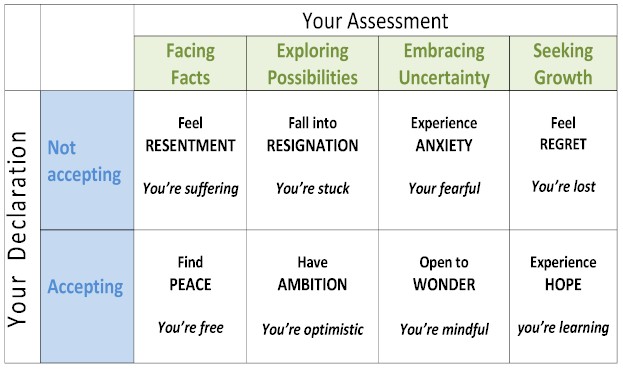
Based on work by Alan Sieler at the Newfield Institute.
These preferences can change when they no longer work for us. For example, the concerns and difficulties we experience are “breakdowns” that can have nothing to do with rational thinking but are about emotioning. A ‘breakdown’ can be a disruption or perturbation in the flow of our emotional preferences which can be either negative or positive in their impact.
Mihaly Csikszentmihalyi identified nine component states of achieving flow including a challenge skill, balance, merging action and awareness, clarity of goals, with immediate and unambiguous feedback, concentration on the task at hand, a paradox of control, a transformation of time and a loss of self-consciousness.
To achieve a flow state, a balance must be struck between the challenge of the task and the skill of the performer. If the task is too easy or too difficult, flow cannot occur. If the skill level and challenge level are low there is a “breakdown” in the flow and we experience apathy, worry, and anxiety. When we are relaxed and feel in control these feelings are unlikely to occur.

Mental state in terms of challenge level and skill level
The challenge is to know when emotions serve us and when they don’t, and how to use them to serve our intentions. Life leaders learn how to design the emotional context they want to live in and through practice achieve mastery. This becomes a Way of Being that enables Life Leaders to act in positive, trusting, confident, empathetic and enthusiastic ways without thinking.
What is science telling us?
Neuroscience has made great strides in recent years in understanding how the brain’s nervous system operates. It reveals its physical structures and connections and how they are energised by emotions, thoughts, and actions. It is the emotional brain that is receiving a lot of attention from researchers at the moment as they seek to explain the source of, and ability to control our emotions.
An excellent summary of this research can be found in ‘A General Theory of Love’ by Lewis. Amini and Lannon. They explore:
- What are feelings and why do we have them?
- What are relationships and why do they exist?
- What causes emotional pain and how can it be mended?
- How should we configure society to further emotional health?
- How should we raise our children and what should we teach them?
We all need the answers to these questions to lead more worthwhile lives. If we cannot embrace the uncertainties that love brings we are more likely to waste our life in unnecessary pain and anxiety. For example, in abusive relationships, failed marriages, neglected children and the elderly and unfulfilled ambitions. When we fail to face facts or explore possibilities their non-acceptance only brings, sadness, grief, resentment or great anxiety.
Neurologist Linda Davidoff defines emotion as a feeling that is expressed through physiological functions such as facial expressions, faster heartbeat, and behaviours such as aggression, crying, or covering the face with hands.
Based on discoveries made through neural mapping of the limbic system, the neurobiological explanation of human emotion is that emotion is a pleasant or unpleasant mental state organized in the limbic system of the mammalian brain.
Defined as such, these emotional states are specific manifestations of non-verbally expressed feelings of agreement, amusement, anger, certainty, control, disagreement, disgust, disliking, embarrassment, fear, guilt, happiness, hate, interest, liking, love, sadness, shame, surprise, and uncertainty.
The roots of our anxiety and suffering are all too often unseen and so denied or passed over. Our logical steps to overcome them fail because they contradict our deeply embedded emotional preferences. Emotions are not innately programmed into our brains, but, in fact, are cognitive states resulting from the gathering of information.
Actions are closely aligned and predisposed to produce emotions associated with previous experiences and the thoughts that were used to interpret that at the time. Consequently, emotions aren’t a response to what our brain takes in from our observations, but, rather, are intrinsic to our makeup or how we see ourselves.
“The brain mechanisms that give rise to conscious emotional feelings are not fundamentally different from those that give rise to perceptual conscious experiences.” – Richard Brown
Research compiled by Richard Davidson shows that we all have an emotional style that is composed of six dimensions. Each one relates to a measurable neurological signal when brain activity is monitored. Each dimension corresponds to well-understood emotional circuits in our nervous system which gives it scientific validity.
Their effects are summarised as:
Resilience – the speed at which we shake off setbacks.
Outlook – the ability to sustain a positive mood state
Intuition – the ability to pick up on subtle emotional signals
Awareness – the sensitive observation of own words, feelings and body messages
Context – the ability to use appropriate communication and fitting behaviour
Attention – the capacity to stay focused and not get easily distracted
The way these six types of brain activity interact with each other, either positively or negatively, generates an emotional context that becomes what Maturana calls our “psychic identity”. The neuroplasticity of the brain (nervous system) means these pathways can be developed through learning. Effective leaders have developed these aspects to a point where they become the context and innate thinking from which they lead and live their lives. Human beings have an internal clock that enables them to perceive and estimate periods of time subconsciously.
The impact on our life when these ‘traits’ are not developed is to hinder our ability to lead and live well. When undeveloped they are the source of many of our concerns, problems and high levels of stress. The power of an ontological approach to human change is that it addresses many of these aspects of the neurological activity that impacts our effectiveness as human beings. I explore many of these issues with techniques for developing these “traits” in the website.
The Nature of Emotions
An emotion is a temporary feeling, whereas a mood is a persistent way of looking at life. Both predispose us to act, react and interact in habitual ways. They are shaped by how we assess what we are feeling in our body, how we have interpreted similar emotions in the past and what mood we were in at the time. The diagram below shows how paying attention to a concern enables us to create an assessment which generates feelings in the body. The action we then choose to take is based on the emotional signals experienced and our future intentions or desires

Take anger as an example. If we are in a “couldn’t care less” mood we may feel free to go after what we want and our assessment of what happened in the past could cause us to feel the tension in our body, so we react in the same way by lashing out at those who we blame for our feelings.
If we paid attention to the language we used to make the assessment of how we were feeling in our body and recognised that they were just feelings, we could hold ourselves accountable, change our inner talk and direct our actions more productively to achieve a positive outcome. The key learning point here for Life Leaders is to recognise the power of language to create our reality and to pay attention to our assessments, the stories we attach to them and the mood prevailing at the time.
Emotioning and Relationships
Given that emotioning is part of being human, it is going to play a key role in our relationships with others. We empathise as we feel the emotions being experienced by others. Our moods and emotional outbursts can affect the emotional states of others, by getting either a negative or positive response. Having spent nearly 20 years of my professional life in organisation development I can confirm that from my experience, social change is largely an emotional phenomenon.
When we live in a mood of appreciation and trust we find it easier to cooperate, collaborate, coordinate and be creative with others. Reason and logic rarely get people to commit, unless they are engaged in a legal contract, where bringing something new into the relationship is rarely an option. We are more often seduced into exploring possibilities for action and create a new emotional space for change to take place.
Researchers found that the most common emotions trigger strong bodily sensations, and the bodily maps of these sensations were topographically different for different emotions. The sensation patterns were, however, consistent across different West European and East Asian cultures, highlighting that emotions and their corresponding bodily sensation patterns have a biological basis.

“Emotions adjust not only our mental but also our bodily states. This way they prepare us to react swiftly to the dangers, but also to the opportunities such as pleasurable social interactions present in the environment. Awareness of the corresponding bodily changes may subsequently trigger the conscious emotional sensations, such as the feeling of happiness,” – Professor Lauri Nummenmaa from Aalto University.
I have been engaged in numerous cultural change initiatives where I have seen considerable emotional pain because not enough attention has been given to the emotional needs of individuals seeking to establish new relationships with colleagues, customers, and communities. It’s not easy to give authority away to others or deal with endless breakdowns in communication and workflow. When our nervous systems get perturbed it triggers shifts in our emotional style.
Emotions and Assessments
An emotion can be seen as an assessment or set of judgements about ourselves and our place in the world. They reflect our values, through which we experience our lives and form our opinions and beliefs. So a change in beliefs will change our emotions. How you feel when you notice your car is missing and then when you fond out your spouse has taken it in an emergency to take a neighbour to the hospital will completely change your emotional reaction.
Sadness when suffering a loss is an assessment of an unfortunate situation, and how we feel when we react to it and what other people expect of us. Not all assessments involve emotions. It would depend on how much we had invested in the outcome. Our concerns might be for relationships, loss of trust and intimacy, or what others think of us, in as far as we identify with them.
Emotions in relationships are often a response to assessments (judgements) we have made in the past or about a future declaration we make that could impact on our status, reputation or respect in the present circumstances. We even deny even having them when we reflect on how we reacted in the past. It’s as if we were someone else, just acting the part expected of us when engaging with the script expected in-the-moment. We express anger because it is expected of us when empathising with someone we want to demonstrate our support for. We may even overplay our feelings of concern or anger to give us a sense of superiority.

Courtesy of Chris Chittenden at Talking About Pty Ltd
Emotions give meaning to the circumstances we find ourselves in. They can turn boring events into dramatic or even humorous episodes. As Martin Heidegger observed, they can “tune us in” or “turn us off” to the facts of the world. Emotions can also convert desirable possibilities into declarations of ambition and hope for the future. As we make requests and offers we have a reason in mind, but they are also an expression of the emotions we want to experience. Offering to make someone a cup of coffee can provide a way of feeling good about ourselves, especially when it’s appreciated.
The emotions of love and the human soul
You can touch life but its essence is often too vast for the human mind to contemplate. Sometimes all we can do but be thankful for the ability to experience life itself and the love of others that have made us who we are.
In this video, Julio Olalla talks about the emotion of Gratitude and what it means to him.
References
Coaching to the Human Soul Vol 3 by Alan Sieler. Newfield 2012
Connect by Lyn Boyer. Leadership Options 2011
The Unopened Gift by Dan Newby & Lucy Nunez. Dan Newby 2017
A General Theory of Love by Lewis, Amani & Lannon. Vintage 2000
The Emotional Life of Your Brain by Richard Davidson. Hodder 2013
The Passions by Robert Solomon. Hacket 1993
Flow by Mihaly Csikszentmihalyi. Harper 2013