
LIFE LEADERSHIP DOMAINS
MOOD MANAGERS
– Facing Facts
– Exploring Possibilities
– Embracing Uncertainty
– Seeking Growth
REALITY CREATORS
– Emotioning
– Presencing
– Relating
– Languaging
MOVIE MAKERS
– Inner Producer
– Inner Director
– Inner Scriptwriter
– Inner Actor
ENERGY PRODUCERS
– Inside-Out Energy
– Outside-In Energy
– Top-Down Energy
– Bottom-Up Energy
Presencing
How you gain clarity of mind to use your way of being and acting to have an impact on others.
Leaders are more present when they turn up without a cause or a result in mind. This approach is more suited to a VUCA situation where the future is unpredictable and the processes unreliable. Leaders are more aware that everyone brings a different perspective to the words they hear, their emotions and mood state, openness, body movements and posture.
There is nothing more empowering than a leader who shows humility and moves the atmosphere from “What YOU need to do is ..” [the decision has been made and I need you to comply] to “What can WE do together to ..? [finding a solution that is important to us before a decision is made]. This turns a problem into an opportunity to listen to and learn from each other, which values the diversity of connections and backgrounds to see challenges as an investment in personal growth.
In this item, I investigate the role the physical body plays in concert with your thoughts and emotions. Presencing is an ability to connect with your whole self (mind and body), concerning a given context. You are in a co-creative relationship where you are aware of yourself and another person at the same time. The rapport enables you to blend with another person’s breathing, voice tonality, etc.
Everything happens in and through the body’s biology. Our Way of Being influences how we use our body to move through life – using our muscles, nerves, thoughts, feelings, and will. Our presence determines how well we deal with stress, fear, resistance, and conflict. We see it in a person’s disposition, carriage, personality, and positivity.
We become aware of our presence when we consciously explore the full range of our capacity for controlling movement. As we discover our predispositions to move in a particular way and adopt specific postures we begin to see how new ways of being support changes in posture and movement.
When we feel connected and in harmony with our declared intentions we sense a difference in how we relate to those around us and them with us. These relationships will determine the extent to which others can be “drawn” to us and bring their humanity and gratitude into our lives.
Leadership involves reasoning and showing that we care about relationships and declare an intention to benefit a cause greater than ourselves. Just a shift in our Way of Being can bring calmness, openness, compassionate energy, a sense of purpose and appreciation, into our life that can give it real meaning and purpose. When others sense that we are centred and care about them in the way we talk, emote and hold ourselves under pressure, they, in turn, will trust us to respect, understand, and care about what’s important to them.
“The most precious gift we can offer others is our presence. When mindfulness embraces those we love, they will bloom like flowers.” – Thich Nhat Hanh
“A deep listening: of being open beyond one’s preconceptions and historical ways of making sense.” – Peter Senge
“The ability to connect authentically with the thoughts and feelings of others, to motivate and inspire them toward a desired outcome.” – Robert Quinn
Presence is a state that we intuitively pick up from another person’s demeanour. The body itself conveys stability, physical control, and determination. When we have presence we exude self-confidence, inner strength and total commitment to the concerns and experiences of others. This makes others feel they can share what is important to them, be acknowledged and consider alternative perspectives. Alan Sieler refers to this as “ontological security”, which is about:
“Feeling solid, assured and secure about our being, our place in the world and what we want to create in life.” – Alan Sieler
We act in the world through our body, so as well as having a physical presence it is also important to show that we are present in the moment. That is we are paying attention, listening actively, empathising through gestures, being aware of what is said and being assertive in our opinions.
They can all be observed in our capacity to establish and break rapport. Research shows that the body communicates more than words. The authenticity of emotions and words must complement body posture and gestures. A weak posture and uncontrolled emotions will speak louder than any words that can be spoken.
There are distinctions to be made and practices to be explored to see how best to be physically aware and available in the present moment. When in a state of anxiety we seek to recover our sense of balance in mind and calmness in the body. If we fear our environment we seek to retreat from it. If we are confident we seek to explore and engage with our environment.
Each mood state induces different physiological reactions and combinations of body movements. The way we make sense of things is not just based on thought, the process is embedded in our nervous system that is located throughout the body. It even extends into the realms of the imagination where we can visualise and simulate the mind-body connections in the movies we create our preferred future and our Way of Being in it.
The work of Frederick Alexander has been instrumental in showing how changing the shape and movement of our body can change our mood state and the meaning we give to our experiences. It is the unity of mind and body that we observe in a person’s presence. When mind and body are divided in the way we make sense of the world, what we say and do can become disconnected and we can come across as incoherent and inauthentic in the minds of others.
The Essence of Presencing
Presence is a quality of connection that makes other people feel naturally engaged and included and will attract listeners, imitators, and followers. Presencing is the process of making it happen. When presencing is apparent in a person’s Way of Being, they show a depth of awareness, attention, and rapport that renders them open, connected and compassionate.
We have it when we pay attention to our body posture and movement as this enables us to communicate our mood and desire for connection that will lead us to rapport. We can only do this when we are centred and our mind is quiet and open to “seeing” where others are coming from.
When we are relaxed and alert we can take slow, deep breaths and release our tension and negativity. We become more open to the present situation and connected to what we care about. This gives us choice at the moment and ‘reflect-in-action’. We are centred when we are present, open and connected. Our attention is focused outward and not on our concerns, emotions, and thoughts.
Our mind is open to what is coming inward by seeing and listening without judgment. We will feel the energy and presence of others and pay close attention to establishing a rapport. We are aware of how our biology influences our Way of Being and how we can control it, so we stay conscious and alive to what’s important to us.
Our Way of Being reflects what is going on in our body’s nervous system as it collects and processes our body’s senses and data from outside the body. Our awareness of this leads us to observe how our senses are the medium through which we connect with our environment and relate to other people. We adapt our Way of Being to adjust and present ourselves to the world and make sense of it.
Centering the body
To experience a robust sense of self that is in touch with our identity and dignity it must allow us to be vulnerable and open to new thought patterns. To be resilient in dealing with uncertainty we need to keep ourselves curious about what’s possible and stay balanced. This requires adapting to circumstances and context by being open to learning and questioning conventional wisdom.
The practice of “centring” can increase awareness of our body or soma. It increases our self-awareness and induces a sense of groundedness and calm. It involves relaxing, concentrating on our breathing, taking stock of the body’s tensions and focusing energy on the physiological centre of the body.
What we are seeking is a meditative state that helps us eliminate the constant chatter of thoughts going through our mind, to allow our body, emotions and internal dialogue to work seamlessly together so we can present an authentic and coherent face to the world.
Centring also refers to the merging of left and right functions of the brain. The left side appears to explore linear connections to apply logic, whilst the right side prefers to explore random patterns to help us make sense of complex connections. The result is a clearer focus enabling us to make sense of what is going on and to feel confident about our being without feeling anxious about our doing.
Research also suggests that centring and meditation can help reduce blood pressure and anxiety levels. It is our Inner Actor that practices centring. It helps prepare us for important encounters by clearing the mind of past assertions and accessing our inside energy to defend ourselves and commit to future declarations without going out of control.
Focusing on making grounded assessments, appropriate to the situation and prevailing in the present moment. This relaxes the body so we can be intimate and feel equal with others. Future concerns and memories drop away as we feel connected to both in the present moment. It’s a source of self-esteem and positive energy. But where did the energy you are tapping into at this moment come from? The diagram below shows what can energise our actions in the present moment.

The website contains practices on centring while at rest or in action. Through reflection, we get to know ourselves better and make better choices. Every aspect of our lives involves our body engaging (inside-out energy) with our environment or context (outside-in energy). We have to be aware that our history limits the reality we see today and the possibilities we can imagine for our future. When centered we realise that the only thing that stops us is our assumptions and expectations.
Watch the video that explains the energy of presence in what Patsy Rodenburg refers to as Circles of Energy. She explores presence as the connecting of “give-and-take” energy. This energy moves out to engage and touch others in an attempt to get energy back in. We know this is happening when we are communicating freely and spontaneously. We lose any sense of past or future to stay in the present where we feel alive and good about ourselves. There is no sense of superiority or inferiority. We feel equal. There is no resentment borne of imposition as we are influencing by allowing ourselves to be influenced. We feel at one with others when we are centred in our bodies.
Centred presence
Stuart Heller shows in his work how body attention lies at the core of personal development. What we pay attention to has a powerful influence over pretty well everything we do and what we observe happens around us. Stuart identifies seven states of centred presence that relate to the process of proprioception, which is the body’s natural ability to sense what is happening within its muscles, balance and awareness of the whole body and its positioning.
Much of this process is unconscious, so improving it requires deeper levels of awareness, imagination, learning and control. When young that happens unconsciously. As adults, we need conscious learning and practice to make new proprioceptive skills like driving become an unconscious competence (doing something without thinking).
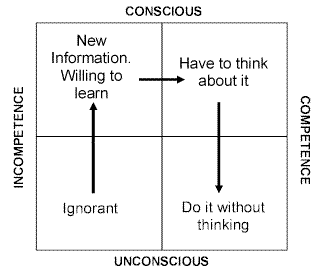
The starting point is simply remembering that we have legs, feet, arms, hands, a spine, a head and how we breathe. It is years of unconscious learning that will have destroyed our natural presence and the messages our body sends to others. Learning to dance in later life requires greater attention to the movement and positioning of the limbs to create presence through strong and sensitive movements that communicate a strength of ‘will’ and a positive mood state towards others.
When you listen to soul singers or jazz musicians, for example, they are so at one with their whole selves that they can create spontaneous harmonies. They imagine drawing their breath from the chest from where the spirit and heart expand.
The Chinese term “Xin” locates the mind in the heart. The message here is that presence involves the essence of expression of the whole person – mind, body, and spirit, unified in our Way of Being.
So presence is drawn from inside us. We do not need to acquire “it”. We must learn how to release “it”. It’s about restoring the natural balance and harmony that releases the flow of energy we hold in our bodies to be at peace in the world.
Heart energy delivers a sensitive presence whereas the mind delivers smart energy. When they combine they create a stronger, sensitive and smart type of presence that we find in Gandhi, King, Mandella, Obama and many of the prophets and wise men of the past.
For the Chinese “Qi” is an example of body energy that connects body and spirit. Our body is the instrument through which we ‘act’, ‘direct’ and ‘produce’ the ‘script’ or story that is our life. When we lead for life we are cultivating the human qualities and habits that will generate the Way of Being to do more of what we want and less of what we don’t want. Cultivating presence encourages others to respond to you differently as you appear more open and present.
Richard Strozzi Heckler focuses on the embodiment of leadership. It’s not what leaders know that makes them effective it’s what they do or how they act. Authentic presence can be learned as an embodied competence.
Leaders who engage in ‘smart’ presence become alienated from the wisdom in their body and distance themselves from the aliveness or feel a sense of living. Our bodies are not just a transport system for our mind. By exploring the living body in its wholeness we can discover the embodied aspects of presence and leadership, namely self-awareness, choice, commitment, purpose and creativity. All of which can energise, reflect, learn and self-generate.
You can discover more by watching videos produced by Integration Training
Somatic awareness
We only become aware of our body when it causes us pain or we are distracted by thought and move in a new direction. Paying attention to these changes are opportunity for learning about our ontology and the way the mind and body work seamlessly together. It is when this automatic process no longer works effectively that we need to intervene. It’s a bit like the way a diabetic has to manage the amount of insulin to deal with excess sugar. A process that we would previously be unaware of until the body experienced the symptoms of a deeper breakdown.
Developing body awareness is an important prerequisite for developing presence. It involves sharpening attention to where our feelings are located in our body and the impact on our emotions of different body postures and gestures. Is it a ‘gut’ feeling? Does your ‘heart’ feel broken? Does your annoyance appear as a “pain in the neck?”
You should practice observing leaders with presence, such as President Barrack Obama when he delivered a speech. After a shooting in a school, he spoke with his head slightly bowed, his voice soft but firm, his eyes looking down and his face stern yet soft. When his words shifted to consider what should be cared about, the posture assumed a more upright position and the voice tone became stronger and the words more positive and assertive.
Obama was aware of his own body and how it influenced his mood and the delivery of his words. These somatic shifts are skillfully made and probably well-practised. They bring together his inner being (nervous system) with his outer body (posture) so they look and feel coherent and authentic. If not, we would sense dishonesty and perceive insincerity, losing confidence and trust.
How do people with a presence move? Do they walk with purpose and poise? Do you sense their energy even when standing still? Are their body movements relaxed yet deliberate? Do they display a straight back and head up, with shoulders square and feet firmly on the floor? Do they engage you and stay focused on the topic or the point?
It is how others perceive the leader’s physical presence that influences the extent to which they trust their leader. What’s more, if we do not feel confident in ourselves it affects how we come across and start to question our ability to deliver what we have promised ourselves. To copy the posture and movements of the President would not be enough.
It would be necessary to model the pace and tone of his voice, his clever choice of words, the sincerity of the message and the compassionate mood state adopted. By recognising the role of your Inner Actor you know that you can fake it until you start to feel it. It’s about copying and practising the characteristics in ways that fit your personality.
It’s about giving the impression or perception that you are in charge or open to what others have to say and care about or creating a strong interpersonal connection. Nelson Mandela generated an atmosphere of love and appreciation through his presence.
He adopted a sense of concern, listening and talking in a non-judgemental way and would always encourage personal responsibility in the solving of problems. He sometimes appeared as subservient, whilst remaining resolute in his beliefs and values.
In my coaching and training work with leaders, it has been a continuing theme that they are aware of their ‘acting’ abilities and how to access their Inner Director to observe and assess their ontology. They know how to review what caused them to interpret their experience in a particular way.
Was it the way their body posture did not communicate their intended meaning or emotional state at the time? It is helpful to be aware of how a resolute or assertive Way of Being may not work well in a situation that requires an empathic response.
Think about how you want to be perceived to have an impact and influence, not just behave as your emotions at the time dictated. If this level of awareness is not automatic it can be learned. It’s about knowing how you want others to feel to commit to a shared outcome. Controlling the body is one thing, attending to emotions can be more difficult to achieve. You will learn more about the ‘affective’ aspects through emotioning.
A presence that influences and inspires
Most leaders believe that influence is the power that comes from aligning vision, beliefs, and intentions with the ability to control and inspire others to follow them. Pushing your agenda by reproducing the right physical gestures and voice tone, will not magnify your presence or convey integrity if you are not perceived to be authentic.
You may be able to influence others with your knowledge and experience, but inspiration is embodied and is sensed as real to the moment and not dependent on an intention from the past or a vested interest to realise in the future. Inspiration comes from something that is authentically valued by you which helps others realise their intentions at the same time.
“Before you can inspire with emotion you must be swamped with it yourself. Before you can move their tears, your own must flow. To convince them, you must yourself believe.” – Winston Churchill
Influence has everything to do with who we are and the way we are in the normal flow of life – not who we say we are or think we are. It is the ways of the leader that are followed, less so the words. This is why character more than personality defines a leader with presence. It is the internal strength displayed through integrity in action when being challenged. Leaders with presence and a desire to inspire will:
- be honest about their flaws
- know what is expected of them
- seek always to be their best selves
- always do what they say
- be approachable and willing to listen
- treat everyone equally
- look to work collaboratively
- manage their mood and emotional state
- base decisions on the best interests of their followers and humanity
When we are inspired by the actions or ideas of someone else, we may be influenced to adopt their different worldview and accept the consequences of our identity. But how do we respond physically, emotionally or intellectually? Usually, if heart and mind are not working in harmony it is difficult to come across as authentic and inspired. When our mind is working without emotion the assessment comes more from reason and argument around verifiable facts.
Presence as a shift in consciousness
People with a presence can see more than one reality at the same time. They know who they are, independent of the expectations and cultural conditioning that they are exposed to. As you look back you will no doubt have pivotal moments or turning points after which you saw the world differently.
I vividly remember having the privilege of conducting the Birmingham Symphony Orchestra as a student and feeling the wonder of a body working, being centred and present, even hours after the event. I can reproduce the sense of exhilaration to this day. The sense of power came from being at one with the orchestra. I gave my love of the music and they gave that love back to me. I realised I did not have power over the orchestra, they had the power to give their best or not depending on us sharing a creative space.
I have been fortunate in having many of these precious moments where I felt a strong sense of presence . . . singing solos as a Chorister in St Bridget’s Church in 1962, working as a VSO in the Solomon Islands in 1969 and escorting the Queen on her visit to Livingston New Town in 1977. I felt humbled and proud at the same time and subsequently never shy or overconfident when meeting people from all walks of life.
I viewed myself differently. These experiences made me realise that presence can be learned and also be undermined if we do not pay close enough attention to our language, mood state and body posture. There is so much that we learn from the presence that we rediscover when reflecting on how we were, in terms of our Way of Being when we had “it”.
The transformation to a greater sense of presence comes from becoming more ‘awake’ to a greater self-awareness (inside-out view), your relationships with your environment (outside-in view) and the people in your life (bottom-up view), not to mention a connection with something greater than yourself (top-down view). You become aware of living in multiple realities or perspectives that ground your assessments, assertions, and declarations.
Achieving presence often means changing the way you see the world and see yourself. It’s more than a skill or a change in your point of view, it’s a major shift in your whole perception of what’s possible. Presence is an insight that happens at the body level when you feel the joy of finding a passion in your life. The level of energy, commitment and enthusiasm has to rise to a point where others cannot pay attention.
Leader presence
Embodying presence takes practice. To be a leader you need to be confident in your body and willing to face up to the facts created by physical confrontation. It requires a stance or demeanour that embodies inner strength, balance, and personal power.
“Behind your thoughts and feelings, there stands a mighty ruler, an unknown sage – whose name is self. In your body it dwells; it is your body.” – Frederich Nietzsche
“The past is history in our flesh, the present is the centre of being and action, and the future is the trajectory of our felt imagination. It is only through our body that we are present and make sense to others.” – Richard Strozzi-Heckler
The way we shape our body determines whether others will choose to move toward us, away from us, against us, or be indifferent to us. The body we are will shape the leader we will be.
Leaders with presence tend to have a positive “can-do” attitude and display . . . .
- Agility
- Accountability
- Resourcefulness
- Resilience
- Authenticity
- Aliveness
Otto Sharma asks us to think of presencing as ‘pre-sensing’ or bringing into the present a different way of being that represents our highest and most noble intention as a human being and is to be found deep inside ourselves – not out there. It is an intention we build for ourselves that takes the form of leadership for our own life – who we are now and are yet to become.
Sharma’s U Process is seen as a movement through seven core capacities and the actions they realise. Each capacity is a gateway to the next. For example, the capacity to let go of existing worldviews is needed for us to see new possibilities. If we cannot see and feel the gain from a change we’ll not find the will to actualise it. This might mean finding the resources of character and leadership to make it happen. It then becomes our ‘calling’, something we feel we are destined to do.
References
Connect by Lyn Boyer. Leadership Options 2011
Retooling on the Run by Stuart Heckler
Presence by Patsy Rodenburg. Penguin 2009
Coaching to the Human Soul (Vol III) by Alan Sieler. Newfield Inst 2012
The Master and his Emissary by Iain Mc Gilchrist. Yale 2010
The Power of Intention by Wayne Dyer. Hay House 2004
The Innovator’s Way by Bob Dunham & Pete Denning. MIT 2010
Theory U by Otto Scharmer. Published by SOL 2007
Presence by Peter Senge. Published by Nicholas Brearley 2005
Presence-Based Coaching by Doug Silsbee. Published by Jossey-Bass 2008
Being the Effective Leader by Michael Nicholas. Life Success 2008
The Leadership Dojo by Richard Strozzi-Heckler. Frog Books 2007
In this item, I investigate the role the physical body plays in concert with your thoughts and emotions. Presencing is an ability to connected with your whole self (mind and body), with reference to a given context. You are in a co-creative relationship where you are aware of yourself and another person at the same time. The rapport enables you to blend with another person’s breathing, voice tonality, etc.
Everything happens in and through the body’s biology. Our Way of Being influences how we use our body to move through life – using our muscles, nerves, thoughts, feelings, and will. Our presence determines how well we deal with stress, fear, resistance, and conflict. We see it in a person’s disposition, carriage, personality, and positivity. We become aware of our own presence when we consciously explore the full range of our capacity for controlling movement. As we discover our predispositions to move in a particular way and adopt specific postures we begin to see new Ways of Being that is supported by changes in posture and movement.
When we feel connected and in harmony with our declared intentions we sense a difference in how we relate to those around us and them with us. These relationships will determine the extent to which others can be “drawn” to us and bring their humanity and gratitude into our life. Leadership involves reasoning and showing that we care about relationships and declare an intention to benefit a cause greater than ourselves. Just a shift in our Way of Being can bring calmness, openness, compassionate energy, a sense of purpose and appreciation, into our life that can give it real meaning and purpose. When others sense that we are centred and care about them in the way we talk, emote and hold ourselves under pressure, they, in turn, wll trust us to respect, understand and care about what’s important to them.
“The most precious gift we can offer others is our presence. When mindfulness embraces those we love, they will bloom like flowers.” – Thich Nhat Hanh
“A deep listening: of being open beyond one’s preconceptions and historical ways of making sense.” – Peter Senge
“The ability to connect authentically with the thoughts and feelings of others, in order to motivate and inspire them toward a desired outcome.” – Robert Quinn
Presence is a state that we intuitively pick up from another person’s demeanor. The body itself conveying stability, physical control and determination. When we have presence we exude self-confidence, an inner strength and total commitment to the concerns experienced by others in the moment. This makes others feel they share what is important them, feel acknowledged and open to consider and be won over to an alternative worldview. Alan Sieler refers to this as “ontological security”, which is about
“Feeling solid, assured and secure about our being, our place in the world and what we want to create in life.” – Alan Sieler
We act in the world through our body, so as well as having a physical presence it is also important to show that we are present in the moment. That is we are paying attention, listening actively, empathising through gesture, being aware of what is said and assertive in our opinions. They can all be observed in our capacity establish and break rapport. Research shows that the body communicates more than words. Authenticity of emotions and words must complement body posture and gestures. A weak posture and uncontrolled emotions will speak louder than any words that can be spoken.
There are distinctions to be made and practices to be explored in order to see how best to be physically aware and available in the present moment. When in a state of anxiety we seek to recover our sense of balance in mind and calmness in the body. If we fear our environment we seek to retreat from it. If we are confident we seek to explore and engage with our environment. Each mood state induces different physiological reactions and combinations of body movement. The way we make sense of things is not just based on thought, the process is embedded in our nervous system that is located throughout the body. It even extends into the realms of the imagination where we can visualise and simulate the mind-body connections in the movies we create our preferred future and our Way of Being in it.
The work of Frederick Alexander has been instrumental in showing how changing the shape and movement of our body we can change our mood state and the meaning we give to our experiences. It is the unity of mind and body that we observe in a person’s presence. When mind and body are divided in the way we make sense of the world, what we say and do can become disconnected and we can come across as incoherent and inauthentic in the minds of others.
The Essence of PresencingPresence is a quality of connection that makes other people feel naturally engaged and included and will attract listeners, imitators, and followers. Presencing is the process of making it happen. When presencing is apparent in a person’s Way of Being, they show a depth of awareness, attention, and rapport that renders them open, connected and compassionate. We have it when we pay attention to our body posture and movement as this enables us to communicate our mood and desire for connection that will lead us to rapport. We can only do this when we are centered and our mind is quiet and open to “seeing” where others are coming from.
When we are relaxed and alert we can take slow, deep breaths and release any tension and negativity. We become more open to the present situation and connected to what we care about. This gives us choice in the moment and ‘reflect-in-action’. We are centered when we are present, open and connected. Our attention is focused outward and not on our own concerns, emotions, and thoughts. Our mind is open to what is coming inward by seeing and listening without judgement. We will feel the energy and presence of others and pay close attention to establishing a rapport. We are aware of how our biology influences our Way of Being and how we can control it, so we stay conscious and alive to what’s important to us.
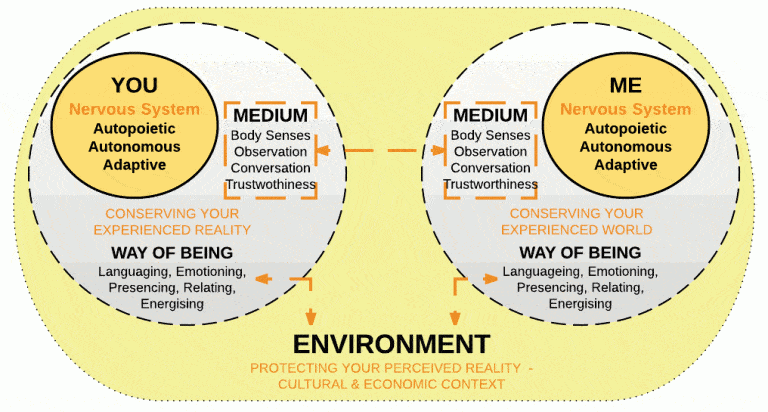
This diagram shows how our Way of Being reflects what is going on in our body’s nervous system as it collects and processes sensory data from inside and outside the body. Our awareness of this leads us to observe how our senses are the medium through which we connect with our environment and relate to other people. We adapt our Way of Being to adjust and present ourselves to the world and make sense of it.
Centering the body
To experience a robust sense of self that is in touch with our identity and dignity it must allow us to be vulnerable and open to new thought patterns. To be resilient in dealing with uncertainty we need to keep ourselves curious about what’s possible and stay balanced. This requires an ability to adapt to circumstances and context by being open to learning and questioning conventional wisdom.
The practice of “centering” can increase awareness of our body or soma. It increases our self-awareness and induces a sense of groundedness and calm. It involves relaxing, concentrating on our breathing, taking stock of the body’s tensions and focusing energy on the physiological centre of the body. What we are seeking is a meditative state that helps to us eliminate the constant chatter of thoughts going through our mind, to allow body, emotions and our internal dialogue to work seemlessly together so we can present an authentic and coherent face to the world.
Centring also refers to the merging of left and right functions of the brain. The left side appears to explore linear connections to apply logic, whilst the right side prefers to explore random patterns to help us makes sense of complex connections. The result is a clearer focus enabling us to make sense of what is actually going on, and to feel confident about our being without feeling anxious about our doing.
Research also suggests that centering and meditation can help reduce blood pressure and anxiety levels. It is our inner Actor that practices centering. It helps prepare us for important encounters by clearing the mind of past assertions and accessing our inside energy to defend ourselves and commit to future declarations without going out of control. Focusing on making grounded assessments, appropriate to the situation and prevailing in the present moment. This relaxes the body so we can be intimate and feel equal with others. Future concerns and past memories drop away as we feel connected to both in the present moment. It’s a source of self-esteem and positive energy. But where did the energy you are tapping into at this moment come from? The diagram below shows what can energise our action in the present moment.
The website contains practices on centering while at rest or in action. It’s through reflection that we get to know ourselves better and make better choices. Every aspect of our lives involves our body engaging (inside-out energy) with our environment or context (outside-in energy). We have to be aware that our history limits the reality we see today and the possibilities we can imagine for our future. When centred we realise that the only thing that stops us realising our potential is own own assumptions and expectations.
Watch the video that explains the energy of presence in what Patsy Rodenburg refers to as Circles of Energy. She explores presence as the connecting of “give-and-take” energy. This energy moves out to engage and touch others in an attempt to get energy back in. We know this is happening when we are communicating freely and spontaneously. We lose any sense of past or future to stay in the present where we feel alive and good about ourselves. There is no sense of superiority or inferiority. We feel equal. There is no resentment borne of imposition as we are influencing by allowing ourselves to be influenced. We feel at one with others when we are centered in our own body.
Centred presence
Stuart Heller shows in his work how body-attention lies at the core of personal development. What we pay attention to has a powerful influence over pretty well everything we do and what we observe happens around us. Stuart identifies seven states of centered presence that relates to the process of proprioception, which is the body’s natural ability to sense what is happening within its muscles, balance and awareness of the whole body and its positioning. Much of this process is unconscious, so improving it requires deeper levels of awareness, imagination, learning and control. When young that happens unconsciously. As adults, we need conscious learning and practice to make new proprioceptive skills like driving become an unconsciuous competence.
The starting point is simply remembering that we have legs, feet, arms, hands, a spine, head and how we breathe. It is years of unconscious learning that will have destroyed our natural presence and the messages our body sends to others. Learning to dance in later life requires greater attention to the movement and positioning of the limbs to create presence through strong and sensitive movements that communicate a strength of ‘will’ and a positive mood state towards others. When you listen to soul singers or jazz musicians for example, they are so at one with their whole selves that they can create spontaneous harmonies. They imagine drawing their breath from the chest from where the spirit and heart expand. The Chinese term “Xin” locates the mind in the heart. The message here is that presence involves the essence or expression of the whole person – mind, body, and spirit, unified in our Way of Being.
So presence is drawn from inside us. We do not need to acquire “it”. We must learn how to release “it”. It’s about restoring the natural balance and harmony that releases the flow of energy we hold in our body to be at peace in the world. Heart energy delivers a sensitive presence where the mind delivers smart energy. When they combine they create a stronger, sensitive and smart type of presence that we find in Gandhi, King, Mandella, Obama and many of the prophets and wise men of the past.
For the Chinese “Qi” is an example of body energy that connects body and spirit. Our body is the instrument through which we ‘act’, ‘direct’ and ‘produce’ the ‘script’ or story that is our life. When we lead for life we are cultivating the human qualities and habits that will generate the Way of Being to do more of what we want and less of what we don’t want. Cultivating presence encourages others to respond to you differently as you appear more open and present.
Richard Strozzi Heckler focuses on the embodiment of leadership. It’s not what leaders know that makes them effective it’s what they do or how they act. Authentic presence can be learned as an embodied competence. Leaders who engage in ‘smart’ presence become alienated from the wisdom in their body and distance themselves from the aliveness or felt-sense of living. Our bodies are not just a transport system for our mind. By exploring the living body in its wholeness we can discover the embodied aspects of presence and leadership, namely self-awareness, choice, commitment, purpose and creativity. All of which have the capacity to energise, reflect, learn and self-generate.
You can discover more by watching videos produced by Integration Training
Somatic awareness
We only become aware of our body when it causes us pain or we are distracted by a thought and move in a new direction. Paying attention to these changes are opportunities for learning about our ontology and the way the mind and body work seamlessly together. It is when this automatic process no longer works effectively that we need to intervene. It’s a bit like the way a diabetic has to manage the amount of insulin to deal with excess sugar. A process that we would previously be unaware of until the body experienced the symptoms of a deeper breakdown.
Developing body awareness is an important prerequisite for developing presence. It involves sharpening attention to where our feelings are located in our body, the impact on our emotions of different body postures and gestures. Is it really a ‘gut’ feeling? Does your ‘heart’ feel broken? Does your annoyance appear as a “pain in the neck’?
You should practice observing leaders with presence, such as President Barrack Obama when he delivered a speech. After a shooting in a school he spoke his with his head slightly bowed, his voice soft but firm, his eyes looking down and his face stern yet soft. When his words shifted to what we should be doing to support and care his posture lifts into a more upright position and his voice tone became stronger and his words more positive and assertive. It is clear that the President is aware of his own body and how it influences his mood and the delivery of his words. These somatic shifts are skilfully made and probably well practiced to bring together his inner being (nervous system) with his outer body (posture) so they look and feel coherent and authentic. If not, observers sense dishonesty and perceive insincerity, so they lose confidence and trust in the person.
How do people with presence move? Do they walk with purpose and poise? Do you sense their energy even when standing still? Are their body movements relaxed yet deliberate? Do they display a straight back and head up, with shoulders square and feet firmly on the floor? Do they engage you and stay focused on the topic or the point?
It is how others perceive the leader’s physical presence that influences the extent to which they trust their leader. What’s more, if we do not feel confident in ourselves it affects how we come across and start to question our ability to deliver what we have promised ourselves. To copy the posture and movements of the President would not be enough. It would be necessary to model the pace and tone of his voice, his clever choice of words, the sincerity of the message and the compassionate mood state adopted. By recognising the role of your Inner Actor you know that you can fake it until you start to feel it. It’s about copying and practicing the characteristics in ways that fit your personality. It’s about giving the impression or perception that you are in charge or open to what others have to say and care about, or create a strong interpersonal connection. Nelson Mandela generated an atmosphere of love and appreciation through his presence. He adopted a sense of concern, listening and talking in a non-judgemental way and would always encourage personal responsibility in the solving of problems. He sometimes appeared as subservient, whilst remaining resolute in his belief and values.
In my coaching and training work with leaders, it has been a continuing theme that they are aware of their ‘acting’ abilities and how to access their Inner Director to observe and assess their own ontology. They know how to review what may have caused them to interpret their experience in the way they have because of the way their body may not have communicated the meaning intended by the words or emotional state at the time. It is helpful to be aware that a resolute or assertive Way of Being may not work well in a situation that required empathy or flexibility.
Think about how you want to be perceived to have an influence, not just unconsciously behave as your emotions at the time dictated. If this level of awareness is not instinctive it can be learned and you find out how in my Self Study Guides. It’s about knowing how you want others to feel to respond and commit to a shared outcome. Controlling the body is one thing, attending to emotions can be more difficult. You will learn more about the ‘affective’ aspects through emotioning.
Presence that influences and inspires
Most leaders believe that influence is the power that comes from aligning vision, beliefs, and intentions with the ability to control and inspire others to follow them. Pushing your personal agenda by reproducing the right physical gestures and voice tone, will not magnify your presence or convey integrity if you are not perceived to be authentic. You may be able to influence others with your knowledge and experience, but inspiration is embodied and is sensed as real to the moment and not dependent on an intention from the past or a vested interest to realise in the future. Inspiration comes from something that is authentically valued by you which helps others realise their intentions at the same time.
“Before you can inspire with emotion you must be swamped with it yourself. Before you can mve their tears, your own must flow. To convince them, you must yourself believe.” – Winston Churchill
Influence has everything to do with who we are and the way we are in the normal flow of life – not who we say we are or think we are. It is the ways of the leader that are followed, less so the words. This is why character more than personality defines a leader with presence. It is the internal strength displayed through integrity in action when being challenged. Leaders with presence a desire to inspire will:
- be honest about their flaws
- know what is expected of them
- seek always to be their best selves
- always do what they say
- be approachable and willing to listen
- treat everyone equally
- look to work collaboratively
- manage their mood and emotional state
- base decisions on the best interests of their followers and humanity
When we are inspired by the actions or ideas of someone else, we may be influenced to adopt their different worldview and accept the consequences for our identity. But how do we respond ? Physically, emotionally or intellectually? Usually, when heart and mind are working in harmony it is difficult not to come across as authentic and inspire. When our mind is working alone the influence comes more from reason and argument around verifiable facts.
Presence as a shift in consciousness
People with presence are able to see more than one reality at the same time. They know who they really are, independent of the expectations and cultural conditioning that they are exposed to. As you look back you will no doubt have pivotal moments or turning points after which you saw the world in a different way.
I vividly remember having the privilege of conducting the Birmingham Symphony Orchestra as a student and feeling the wonder of a body working, being centered and totally present, even hours after the event. I can reproduce the sense of exhilaration to this day. The sense of power came from being at one with the orchestra. I gave my love of the music and they gave that love back to me. I realised I did not have power over the orchestra, they had the power to give of their best or not depending on us sharing a creative space.
I have been fortunate in having many of these precious moments where I felt a strong sense of presence . . . singing solos as a Chorister in St Bridget’s Church in 1962, working as a VSO in the Solomon Islands in 1969 and escorting the Queen on her visit to Livingston New Town in 1977. I felt humbled and proud at the same time and subsequently never shy or overconfident when meeting people from all walks of life. I viewed myself differently. These experiences made me realise that presence can be learned and also be undermined if we do not pay close enough attention to our language, mood state and body posture. It so much that we learn presence that we rediscover it from reflecting on how we were, in terms of our Way of Being, when we had “it”.
The transformation to a greater sense of presence comes from becoming more ‘awake’ to a greater self-awareness (inside-out view), your relationships with your environment (outside-in view) and the people in your life (bottom-up view), not to mention a connection with something greater than yourself (top-down view). You become aware of living in multiple realities or perspectives that ground your assessments, assertions, and declarations. Achieving presence often means changing the way you see the world and see yourself. It’s more than a skill or a change in your point of view, its a major shift in your whole perception of what’s possible. Presence is an insight that happens at the body level when you feel the joy of finding a passion in your life. The level of energy, commitment and enthusiasm rises to a point where others cannot not pay attention.
Leader presence
Embodying presence takes practice. To be a leader you need to be confident in your body and willing to face up to the facts created by physical confrontation. It requires a stance or demeanor that embodies inner strength, balance, and personal power.
“Behind your thoughts and feelings there stands a mighty ruler, an unknown sage – whose name is self. In your body it dwells; it is your body.” – Frederich Nietzsche
“The past is history in our flesh, the present is the centre of being and action, and the future is the tradjectory of our felt imagination. It is only through our body that we are present and make sense to others.” – Richard Strozzi-Heckler
The way we shape our body determines whether others will choose to move toward us, away from us, against us, or be indifferent to us. The body we are will shape the leader we will be.
Leaders with presence tend to have a positive “can-do” attitude and display . . . .
- Agility
- Accountability
- Resourcefulness
- Resilience
- Authenticity
- Aliveness
Otto Sharma asks us to think of presencing as ‘pre-sensing’ or bringing into the present a different way of being that represents our highest and most noble intention as a human being and is to be found deep inside ourselves – not out there. It is an intention we build for ourselves that takes the form of leadership for our own life – who we are now and are yet to become.
Sharma’s U Process is seen as movement through seven core capacities and the actions they realise. Each capacity is a gateway to the next. For example, the capacity to let go of existing worldviews is needed for us to see new possibilities. If we cannot see and feel the gain from a change we’ll not find the will to actualise it. This might mean finding the resources of character and leadership to make it happen. It then becomes our ‘calling’, something we feel we are destined to do.
References
Connect by Lyn Boyer. Leadership Options 2011
Retooling on the Run by Stuart Heckler
Presence by Patsy Rodenburg. Penguin 2009
Coaching to the Human Soul (Vol III) by Alan Sieler. Newfield Inst 2012
The Master and his Emissary by Iain Mc Gilchrist. Yale 2010
The Power of Intention by Wayne Dyer. Hay House 2004
The Innovator’s Way by Bob Dunham & Pete Denning. MIT 2010
Theory U by Otto Scharmer. Published by SOL 2007
Presence by Peter Senge. Published by Nicholas Brearley 2005
Presence-Based Coaching by Doug Silsbee. Published by Jossey-Bass 2008
Being the Effective Leader by Michael Nicholas. Life Success 2008
The Leadership Dojo by Richard Strozzi-Heckler. Frog Books 2007